The two figures stood behind the anchor desk, poised and professional, as the lights came up at the Beijing forum. One was female, one male. Both were dressed for broadcast. Both had the posture, the presence, the composure that news anchors cultivate over years of live television. When the opening segment began, it was the female anchor who spoke first — reading the news clearly, in Mandarin, with the measured cadence that state media demands.
Her name is Xinyan. Her colleague is Xinyu. Neither is human.
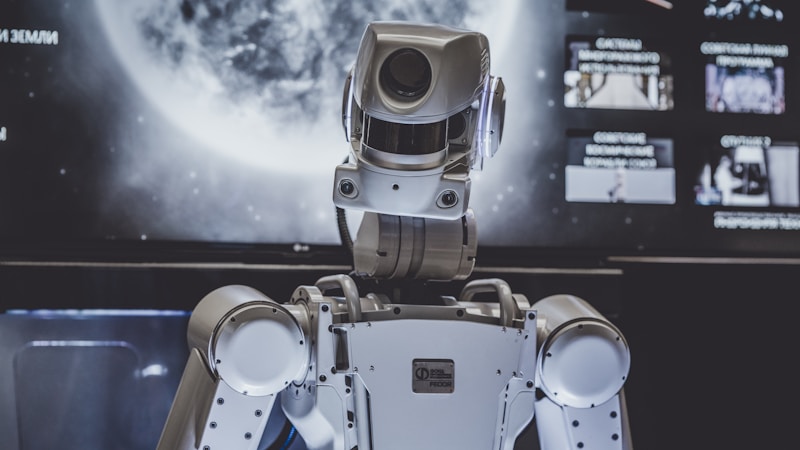
On November 5, 2026, at the Artificial Intelligence and China's Modernization forum — part of the 7th World Media Summit — Xinhua News Agency unveiled what it described as the world's first bionic humanoid robot news anchors. The robots, developed jointly by Xinhua and UBTECH Robotics with visual design led by renowned film director Zhang Yimou, are built at true 1:1 human scale with synthetic skin and human-like movement systems. They read the news on camera. They interact with people around them. They speak multiple languages.
The immediate reaction focused on the spectacle. But the more consequential story is what the launch represents: China's humanoid robot industry, already dominant in industrial deployment, is now crossing the boundary from factory floors into professional service roles. And the Chinese government has made it national policy to accelerate that transition — with a target of 10,000 deployed humanoid units by the end of 2026 and more than 100 high-value application scenarios across industry, services, and specialized sectors.
This is the story of how that happened, and what it means for the global labor market.
The Scale of the Shift
To understand the speed of this transition, consider the sequence. In 2025, China's humanoid robot industry was largely a demonstration business — companies showed off backflipping robots at trade shows. In 2026, that changed fundamentally.
According to China's Ministry of Industry and Information Technology (MIIT), annual humanoid robot output is on track to exceed 100,000 units in 2026, representing year-on-year growth of approximately 594%. Annual terminal delivery volume is expected to reach 50,000 units — more than 90% of global humanoid robot deliveries. Over 120 listed manufacturers have deployed humanoid robots on production lines. Industrial procurement orders now account for 56% of annual shipments — the majority are being bought to do actual work, not for demonstration.
What is genuinely new in late 2026 is the migration into service and professional environments — roles requiring social interaction, physical presence in public spaces, and the ability to function in unstructured, human-centered settings.
| Deployment Sector | Example Deployments | Scale (2026) | Role Type |
|---|---|---|---|
| News media | Xinhua (Xinyan, Xinyu) | 2 units unveiled; expansion planned | On-camera broadcasting, multilingual presentation |
| Border control | UBTECH Walker S2 at Fangchenggang, Guangxi | ~$37M contract | Queue guidance, vehicle direction, container ID verification |
| Traffic management | SUPCON T2 in Hangzhou | 15 units active; 200 planned across 8 cities | Violation flagging via camera and radar |
| Logistics | Robotera at China Post, SF Holding | 10+ distribution centers | Parcel sorting, material transport |
| Automotive manufacturing | Galbot S1 at CATL; Leju at FAW, Changhong | 120+ listed manufacturers | Assembly line work, quality inspection |
| Electronics assembly | AgiBot (Zhiyuan) at Longcheer Technology | Pilot; livestreamed April 2026 | Tablet assembly line |
| Garment production | Aitu at Sunrise Group, Eifini, Chenfeng | Production trials ongoing | Sewing, material handling |
| Museums/cultural | Xinhua robots (planned) | 5 application scenarios announced | Guiding, cultural exchange, education |
The table reveals a pattern. The earliest deployments — logistics, manufacturing, assembly — are tasks that humanoid robots share with traditional industrial robots. The newer deployments — news anchors, border crossing assistants, traffic controllers — require a fundamentally different kind of machine: one that can navigate human spaces, interact socially, and present itself professionally.
The Newsroom Experiment
The Xinhua robots deserve a closer look, because they embody a design philosophy that distinguishes China's approach to service robotics from anything happening in the West.
The technical architecture has three layers: brain, expression, and control. Rather than allowing the robots to generate news from a general-purpose large language model, the robots retrieve only from a pre-vetted, government-approved content database.
| Layer | Technology | Function |
|---|---|---|
| Brain | Xinhua Yudian AI agent | Curated news corpus; every statement traceable and verifiable |
| Expression | UBTECH multimodal model + bionic expression | Full-duplex interaction — simultaneous listening and responding |
| Control | Bionic movement system | Natural head turns, hand gestures, facial expressions |
The "expression" layer achieves full-duplex interaction — the robots can listen and respond simultaneously, rather than in the turn-taking manner that makes most human-robot conversations feel stilted.
Qian Tong, director of Xinhua's New Media Center, framed the robots as assistive rather than replacement technology. "The robotic anchor is a new type of role in the editorial department, rather than a new protagonist," Qian said.
But the distinction between "assisting" and "replacing" may prove thinner in practice than it sounds in a launch presentation. The robots' assigned tasks — reading news on camera, presenting information, providing multilingual summaries — are precisely the jobs that human news anchors, museum guides, and receptionists currently perform.
Xinhua and UBTECH have announced five regular application areas: cultural relics and museums, education, government affairs, external communication, and frontier exploration — including deep-space exploration reporting. Each of these is a professional service role that has historically required a human presence.
Beyond the Newsroom: The Service Economy Wave
The Xinhua launch is the highest-profile example of a broader phenomenon that has been building throughout 2026. Across China, humanoid robots are being deployed into service roles that were, until recently, exclusively human domains.
The most instructive case is the Fangchenggang border crossing in Guangxi province, near the Vietnam border. UBTECH won a contract worth approximately $37 million to station Walker S2 humanoid robots at the crossing, where they perform queue guidance, vehicle direction, and container ID verification. Human officers still handle enforcement decisions — but the physical presence of humanoid machines at an international border represents a category of deployment with no precedent.
In Hangzhou, SUPCON Information deployed 15 T2 humanoid robots for traffic control around the West Lake scenic area starting May 1, 2026. The robots monitor traffic violations using cameras and radar, flagging infractions for human officers who make the final call on enforcement. SUPCON plans to expand to approximately 200 units across eight cities by the end of 2026.
In logistics centers across China, Beijing-based Robotera has placed humanoid robots in more than 10 distribution centers operated by China Post and SF Holding. The robots sort and move parcels in environments designed for human workers — which is precisely the point. Humanoid robots can be deployed into existing human infrastructure without the facility redesigns required for traditional automation.
And at the WAIC 2026 conference in Shanghai, nearly 60 humanoid robots performed actual on-site duties — guiding visitors, providing information, assisting with registration. The Zhiyuan Expedition A3 Ultra operated as a "24-hour premium receptionist," navigating the venue with 360-degree vision and LiDAR through crowded, dynamic environments.
| Company | Robot Model | Service Role | Deployment Status |
|---|---|---|---|
| Xinhua/UBTECH | Xinyan, Xinyu | News broadcasting, presentation | Unveiled Nov 5, 2026; expansion planned |
| UBTECH | Walker S2 | Border crossing assistance | Active at Fangchenggang, Guangxi |
| SUPCON | T2 | Traffic monitoring, violation flagging | 15 active in Hangzhou; 200 planned |
| Robotera | Custom humanoids | Logistics sorting, parcel handling | 10+ China Post / SF Holding centers |
| AgiBot (Zhiyuan) | Expedition A3 Ultra | Reception, venue guidance | WAIC 2026; commercial deployments |
| Galbot | S1 | Factory line operations, reception | 24/7 at CATL for 3+ months |
| Leju Robotics | Kuavo platform | Factory demonstration, depalletizing | Bulk orders from FAW, Changhong |
The common thread: these robots are not replacing industrial machinery — they are replacing or augmenting human labor in service contexts. The border crossing does not need a robot; it needs a person who can stand for hours, direct vehicles, verify documents, and communicate clearly. Until now, that person had to be human. In Guangxi, that is no longer strictly true.
The Machine Behind the Machines
The technology enabling this transition is the product of a manufacturing and AI ecosystem that China has spent the past three years building — often in response to US export controls that cut off access to the most advanced foreign components.
The critical enabler is the embodied AI stack: large language models for natural language, computer vision for environmental perception, robotic control systems for movement, and increasingly sophisticated sensors for touch and spatial awareness. Alibaba's Qwen models — which passed 3 billion cumulative downloads on Hugging Face in 2026 — provide the language backbone for many robotics applications. The open-source ecosystem around Qwen and DeepSeek gives Chinese robotics companies state-of-the-art AI without licensing fees or API dependencies on foreign providers.
But the deeper advantage is manufacturing. Unitree's G1 humanoid — a capable, full-size platform — sells for approximately $13,500, and its smaller R1 starts at roughly $4,900. By comparison, 1X Technologies' NEO home robot, one of the few Western humanoids available to consumers, costs $20,000 or $499 per month.
This cost advantage reflects an integrated supply chain where component manufacturers, robot assemblers, and AI developers are clustered in the same geographic corridors — Shenzhen for hardware, Hangzhou for AI, Beijing for research and policy — and can iterate on each other's designs in weeks rather than quarters.
The robotics funding data underscores the momentum: 407 disclosed deals in 2026, including $290 million for Spirit AI (千寻智能), $200 million for LimX Dynamics (逐际动力), and $145 million for Galaxea AI (星海图). AgiBot (Zhiyuan Robotics) is reportedly targeting an IPO at a valuation between $5.1 billion and $6.4 billion. Unitree listed on the Shanghai Stock Exchange in 2026 at approximately $9 billion.
| Cost Component | Chinese Humanoid (Unitree G1) | Western Equivalent | Chinese Advantage |
|---|---|---|---|
| Base platform | ~$13,500 | $50,000–$200,000+ (Figure, Apptronik) | ~70–90% lower |
| Actuators (joint motors) | Domestic supply; Shenzhen cluster | Imported or custom-built | 3–5x cheaper |
| AI model backbone | Open-source (Qwen, DeepSeek) | Proprietary (OpenAI, Google licensing) | Zero licensing cost |
| Sensors (LiDAR, vision) | Domestic: Hesai, RoboSense | Velodyne, Ouster imports | 2–4x cheaper |
| Battery | CATL and BYD supply chain | LG, Panasonic imports | Integrated advantage |
| Time to iterate design | Weeks (clustered supply chain) | Months (distributed suppliers) | Speed advantage |
The cost differential has a compounding effect. Cheaper robots mean more deployments. More deployments generate more operational data. More data improves the AI models. This flywheel is why the gap between Chinese and Western humanoid robotics is widening rather than narrowing.
The Government Hand
None of this would be happening at this speed without explicit government intervention. In June 2026, China's Ministry of Industry and Information Technology and the State-owned Assets Supervision and Administration Commission (SASAC) jointly launched a nationwide humanoid robot deployment program that reads more like an industrial mobilization order than a technology policy.
The mandate is specific: 10,000 humanoid robots in regular deployment by the end of 2026, across more than 100 high-value application scenarios spanning manufacturing, healthcare, warehousing, and disaster relief. Provincial governments and state-owned enterprises were required to file implementation plans by June 2026 and progress reports by November 2026. This is not a suggestion. It is a directive with deadlines, reporting requirements, and the implicit weight of the Chinese state behind it.
The policy logic is straightforward. China faces a demographic challenge that no other major economy shares in the same magnitude: a shrinking working-age population projected to lose millions of workers per year over the coming decades. Humanoid robots — machines that can work in human-designed spaces without facility modification — are seen as a structural solution to a structural problem.
But the mandate serves a second purpose: data collection at scale. Every deployed robot is a sensor platform generating training data. Hundreds of robots in diverse, unstructured environments feeding operational data back to manufacturers — a data flywheel no private company could replicate.
This is the part of China's robotics strategy that Western analysts consistently underestimate. It is not just about building better robots. It is about creating the world's largest real-world training dataset for embodied AI — and using state power to generate it on an accelerated timeline.

The Global Context: A Widening Gap
The contrast with the rest of the world is stark. As of May 2026, China commanded approximately 80% of the global humanoid robot market by shipment volume. In March 2026, China released its first comprehensive national standard system for humanoid robots — a six-part framework covering foundational technologies, brain-like computing, components, complete systems, applications, and safety.
In the United States, the response has been legislative rather than industrial. The Humanoid ROBOT Act (S.3275) would bar federal procurement of Chinese-linked humanoid robots. The American Security Robotics Act targets Chinese-made robotic systems. Congress has encouraged the Pentagon to designate Unitree Robotics as a "Chinese military company."
The concern is not unfounded. A humanoid robot in a federal building would have access to physical spaces, communication networks, and sensitive documents that no network security could fully protect against. But the legislative approach highlights a strategic asymmetry: while the US is writing laws to keep Chinese robots out of government buildings, China is deploying robots at its border crossings, in its newsrooms, and on its factory floors. One country is playing defense; the other is building an industry.
Elon Musk acknowledged the gap in January 2026: "China is next level." Tesla's Fremont factory is targeting up to 1 million Optimus units annually — a figure that, if achieved, would rival China's production volumes. But as of November 2026, Tesla has not published verified third-party deployment unit counts, and the company's mass production timeline has shifted repeatedly.
| Metric | China | United States | Gap |
|---|---|---|---|
| 2026 humanoid output | ~100,000 units (projected) | ~5,000–10,000 units (estimated) | 10–20x |
| Global market share (shipments) | ~80–90% | ~5–10% | Dominant |
| Cost of entry-level platform | $4,900 (Unitree R1) | $20,000 (1X NEO) | 4x cheaper |
| Government deployment mandate | 10,000 units by end-2026 | None | Policy-driven |
| National standards framework | Six-part system (March 2026) | None | Regulatory gap |
| Robotics VC deals (2026) | 407 deals | ~120 deals (estimated) | 3.4x |
| IPO pipeline | Unitree (listed), AgiBot (targeting) | Figure (private), Agility (SPAC) | Capital market depth |
The gap is not purely technological. Boston Dynamics' Atlas remains arguably the most advanced humanoid in terms of pure autonomy. Figure AI's robots have demonstrated impressive manipulation capabilities. But China's advantage is the integrated ecosystem — manufacturing, AI, government procurement, and real-world deployment converting capability into deployed units at a pace no other country is matching.
The Labor Question
The economic logic of China's humanoid robot push is compelling. But the social implications are less comfortable to discuss — and the Chinese government's own regulatory framework suggests that it is thinking about them carefully.
China's AI safety governance has increasingly focused on employment impact. The NDRC's full-lifecycle AI safety standards, announced in November 2026, require companies whose AI systems could cause significant workforce displacement to monitor and report on employment effects — a provision with no direct equivalent in any other jurisdiction.
The humanoid robot wave sits at the intersection of this concern and the demographic imperative. China needs automation because it is running out of workers. But automation also eliminates the jobs that those workers would have done. The government's answer, so far, has been to frame humanoid robots as tools that augment rather than replace — assistants that handle dangerous, repetitive, or physically demanding tasks while humans focus on higher-value work.
The Xinhua framing is instructive. The robots are "a new type of role in the editorial department, rather than a new protagonist." Every verb is assistive. None is substitutive.
But the tension between framing and reality is already visible. At Fangchenggang, the Walker S2 robots handle queue guidance and document verification — tasks previously performed by human border staff. In Hangzhou, the T2 robots flag traffic violations — previously a traffic officer's job. In logistics centers, robots sort parcels — previously warehouse work.
The question is not whether these robots will replace workers. In many deployments, they already are. The question is whether China's regulatory framework — with employment impact monitoring and lifecycle safety standards — can manage the transition at a pace that maintains social stability. It is, in many ways, the defining policy experiment of the AI era.
What Comes Next
The trajectory for 2027 and beyond is already visible in the current deployment patterns. Several trends are likely to accelerate.
First, cost will continue to fall. Unitree's R1 at $4,900 is already cheaper than a year of minimum-wage labor in many Chinese cities. As production scales, the economic case for humanoid robots in service roles will become overwhelming — not just in China but globally.
Second, the service economy will expand beyond current pilots. The Xinhua robots' planned deployment in museums, government reception halls, and overseas cultural exchanges represents a template that will be replicated across China's vast state sector.
Third, the data advantage will compound. With 10,000 government-mandated deployments generating real-world operational data by end-2026, Chinese humanoid robots will improve faster than Western competitors — a gap that will be difficult to close without equivalent deployment scale.
Fourth, geopolitical friction will intensify. US legislation will create a bifurcated market where Chinese robots are excluded from Western government procurement but dominant everywhere else — accelerating parallel robotics ecosystems with different standards and supply chains.
The Xinhua news anchors, for all their novelty, are not the story. They are the press release. The story is the hundred thousand humanoid robots rolling off Chinese assembly lines this year, the ten thousand government-mandated deployments, the 407 venture capital deals, and the integrated manufacturing-AI-policy ecosystem converting technological capability into deployed units at unprecedented speed.
Xinyan and Xinyu read the opening segment on November 5. Their voices were clear. Their movements were natural. And when they finished, the audience applauded — some with genuine admiration, some with the uncomfortable awareness that they had just watched a preview of their own professional future.
That future is being manufactured in China, at a pace and scale that the rest of the world has not yet begun to comprehend.
Social Media Reactions
知乎 · 机器人行业从业者 (Zhihu — Robotics Industry Practitioner):
新华社这两个机器人真正的意义不在于播报新闻,而在于验证了一条技术路线:大模型+具身硬件+权威语料库。这套架构可以复制到任何需要"可信信息输出"的场景。博物馆的讲解员、银行的理财顾问、医院的导诊员,所有这些岗位都面临同样的技术替代路径。
>
*(The real significance of Xinhua's two robots isn't news broadcasting — it's the validation of a technical architecture: LLM + embodied hardware + authoritative corpus. This stack can be replicated in any scenario requiring "trusted information output." Museum guides, bank advisors, hospital receptionists — all these roles face the same technological displacement pathway.)*
@TechSinologist (Twitter/X):
Xinhua's robot anchors are engineered for content governance, not just presentation. The robots can ONLY pull from Xinhua's pre-vetted news database — they physically cannot hallucinate because they don't use a general LLM for content. This is the opposite of Western AI journalism experiments. It's state media logic embodied in silicon.
>
*(The robots' constraint to a curated database reflects a fundamentally different approach to AI-generated content: eliminate hallucination by eliminating generative freedom.)*
小红书 · 传媒专业学生 (Xiaohongshu — Media Studies Student):
作为学播音主持的学生,看到新闻主播机器人真的有点崩溃。我们花了四年练发音、练仪态、练即兴表达,结果机器人一来就全替代了?不过仔细看,它们目前只能念稿,做不了现场采访和突发报道。也许真正的新闻人反而会更值钱?
>
*(As a broadcasting major, seeing robot news anchors is genuinely distressing. We spent four years practicing pronunciation, posture, and live improvisation — and robots replace all of that instantly? But looking closer, they can only read scripts right now. They can't do field reporting or breaking news coverage. Maybe real journalists will actually become MORE valuable?)*
@CeliaWang_Robotics (Twitter/X):
The Zhang Yimou detail is the most culturally Chinese thing about this story. In the West, you'd hire a UX designer or a Hollywood VFX studio. In China, you get the director of "Hero" and "Raise the Red Lantern" to design your robot's appearance. Because presentation IS the product when the product is information.
>
*(The choice of China's most celebrated filmmaker as the robots' visual designer reflects a cultural understanding that in information delivery, how you present is as important as what you present.)*
微博 · 科技评论人 (Weibo — Tech Commentator):
人形机器人替代白领工作的速度比大多数人预期的快得多。工厂里的机器人替代的是体力劳动者,但新闻主播、博物馆讲解员、接待员这些岗位本来是"安全"的。现在不是了。2027年可能会有更多意想不到的职业被机器人渗透。
>
*(Humanoid robots are replacing white-collar jobs much faster than most people expected. Factory robots replace manual laborers, but news anchors, museum guides, and receptionists were supposed to be "safe" jobs. Not anymore. 2027 will likely see even more unexpected professions penetrated by robots.)*
@EmbodiedAI_Research (Twitter/X):
Everyone focusing on the "robot news anchor" angle is missing the real story. Xinhua is China's most authoritative state media. By putting humanoid robots on camera, they're giving the entire humanoid robotics industry a stamp of legitimacy that no amount of VC funding can buy. This is industrial policy disguised as a media stunt.
>
*(The Xinhua deployment functions as a national endorsement of humanoid robotics — a signal to every provincial government and SOE that robot deployment is not just permitted but encouraged.)*
The Xinhua news anchors will read the news again tomorrow. And the day after that. Each broadcast will be smoother, more natural — not because the robots are learning, though they are, but because the humans watching them are adjusting. Normalization is the most powerful force in technology adoption, and China has just normalized something that much of the world still considers science fiction.
The factory floor was just the beginning.