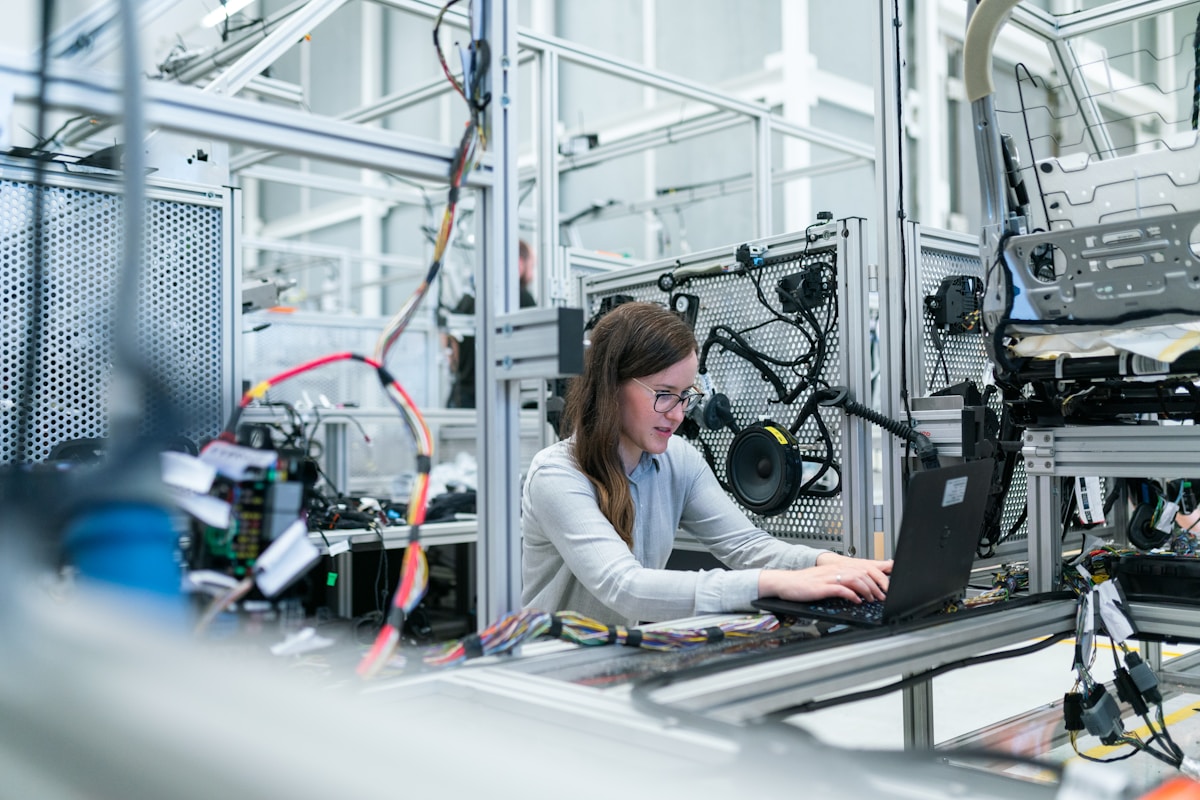
On the afternoon of November 17, 2026, in a conference hall in Shenzhen's Qianhai district, Xiaomi CEO Lei Jun stood before roughly two thousand Asia-Pacific business leaders and described a robot working an eight-hour shift. Not a metaphorical one — an actual embodied robot, deployed on the floor of a Xiaomi smart factory, laboring alongside automated production lines for a full workday. During that shift, it autonomously walked to a charging station and plugged itself in. Twice.
"The integration of AI into the physical world," Lei told the APEC CEO Summit, "will bring enormous business opportunities."
Hours later, on the same stage, Baidu CEO Robin Li delivered what sounded like a warning from a different universe. The AI industry, Li said, was at risk of becoming a bubble. Most companies pouring money into AI had seen no meaningful revenue or profit lift. "For most," he said, "the answer is no" when asked whether AI adoption had raised their bottom line.
Two CEOs. Same stage. Seemingly contradictory messages. But anyone paying close attention to China's technology trajectory understood that they were describing the same phenomenon from two angles: the chatbot era has hit a ceiling, and the next phase of AI — the one that actually makes money — will happen in the physical world.
The phenomenon has a name, and China has already organized its entire industrial policy around it.
The Signal from Shenzhen
The APEC CEO Summit, held November 17–18 in Shenzhen, was supposed to be a trade forum. Instead, it became the clearest public articulation yet of what might be called the "Physical AI Consensus" — the emerging view among China's technology leadership that large language models, chatbots, and generative content tools represent a transitional phase of AI, not its endpoint.
The evidence was not in any single speech but in the lineup itself. Lei Jun spoke about embodied intelligence. Unitree founder Wang Xingxing shared the stage, discussing the path from quadrupeds to humanoids. UBTech CEO Zhou Jian talked robotics deployment. CATL chairman Zeng Yuqun addressed battery energy density for eVTOLs and mobile robots. Even Robin Li, whose company built its reputation on search and language models, used his keynote to argue that value must migrate from foundation models to application-layer workflows.
This was not a random assortment of tech executives. It was a curated cross-section of China's physical AI stack: robots (Unitree, UBTech, Xiaomi), power systems (CATL), and AI platforms (Baidu). The curation sent a message that individual speeches could not: China's AI strategy has already moved on from the chatbot wars.
| Speaker | Company | Role at APEC | Core Message |
|---|---|---|---|
| Lei Jun | Xiaomi | Keynote | Physical AI integration is the next business frontier |
| Robin Li | Baidu | Keynote | AI bubble risk; value must move to application layer |
| Wang Xingxing | Unitree | Panel | Embodied AI represents the path toward AGI |
| Zhou Jian | UBTech | Panel | Humanoid robots entering mass deployment |
| Zeng Yuqun | CATL | Panel | Battery density is the bottleneck for mobile robots |
The timing was deliberate. The APEC Leaders' Meeting, convening November 18–19 with President Xi Jinping and visiting heads of state including US President Donald Trump, placed AI cooperation and governance on the formal agenda. Chinese proposals on AI applications were incorporated into the summit's outcome documents, including a joint "AI+" proposal with the Canadian business community. For the first time in the summit's thirty-year history, results were issued as a formal initiative — the Shenzhen Initiative 2026 — with embodied AI and intelligent manufacturing among its pillars.
What Is Physical AI, and Why Now?
"Physical AI" (物理世界AI) refers to artificial intelligence systems that perceive, reason, and act in the physical world through robotic bodies — as opposed to language models that process and generate text, images, and code on screens. The concept is not new. What is new is the velocity at which it has moved from research curiosity to national industrial policy.
China's embrace of embodied AI follows a signature pattern: identify a strategic technology early, build the world's largest manufacturing and deployment base, then use scale to set global standards. The numbers are stark.
In 2025, Chinese companies shipped approximately 90% of the world's humanoid robots — roughly 18,000 units out of a global total of about 20,000, according to Omdia. Morgan Stanley projects Chinese humanoid robot sales will surge 133% to 28,000 units in 2026. More than 140 domestic manufacturers produce over 330 distinct models. China operates roughly 2 million industrial robots — approximately 4.5 times more than Japan, the global number two — and installs 54% of all industrial robots deployed worldwide annually.
| Metric | Figure | Source |
|---|---|---|
| Global humanoid shipments 2025 | ~20,000 units | Omdia |
| China humanoid shipments 2025 | ~18,000 units (90%) | Omdia |
| Projected China shipments 2026 | 28,000 units (+133%) | Morgan Stanley |
| Chinese humanoid manufacturers | 140+ companies | Industry reports |
| Industrial robots installed annually in China | 54% of global total | IFR World Robotics 2025 |
| China's operational industrial robot stock | ~2 million units | IFR |
| National AI guidance fund | ~$138 billion | APCO Worldwide |
The policy architecture supporting this buildout is comprehensive. Embodied intelligence was first named a key "future industry" in China's 2025 Government Work Report, then codified in the 15th Five-Year Plan (2026–2030), which lists it among the top ten "new industries and new tracks." The plan explicitly calls for coordinated build-out of large-scale training platforms, AI models, core components, and key technologies, with humanoid robots listed as embodied-AI products for accelerated deployment.
In February 2026, the Ministry of Industry and Information Technology (MIIT) unveiled the Humanoid Robot and Embodied Intelligence Standard System (HEIS 2026) — a national framework covering the full industrial chain, drafted by more than 120 research institutions and manufacturers. It establishes whole-body teleoperation as the unified method for high-quality training data collection and introduces an Lv1–Lv5 intelligence grading system for commercial robots.
In June 2026, MIIT and SASAC jointly launched the Real-World Training Special Action, targeting deployment capability of 10,000+ units by end of 2026 across more than 100 high-value use cases. China's State Grid Corporation committed ¥6.8 billion (~$1 billion) to acquire embodied intelligence systems for power grid operations. Total government and enterprise spending on embodied intelligence robots is expected to exceed ¥10 billion ($1.46 billion) in 2026.
The Factory Floor as Proof of Concept
If policy documents tell you where China wants to go, factory floors tell you whether it is getting there. The evidence from Lei Jun's APEC keynote suggests the gap is closing faster than most Western observers expected.
Xiaomi, according to Lei, has already built what he described as a "factory without human workers" — a dark factory where embodied intelligent robots "intern" on the production line, working continuous eight-hour shifts with two autonomous charging cycles. This is not a laboratory demo. It is a production deployment in a company that manufactured over 200 million devices last year.
The dark factory concept — fully robotized production lines requiring no sunlight, no climate control, no human factors — was explicitly introduced in the 15th Five-Year Plan. The idea is simple but radical: if AI can run the factory, the factory becomes a computational problem rather than a labor problem. And China, with the world's largest manufacturing base, has more factory floors to convert than any competitor.
Xiaomi is not alone. XPeng plans to mass-produce its IRON humanoid robot by the end of 2026, with commercial sales and external deliveries following in 2027. BYD has deployed humanoid robots in automotive assembly trials. Chinese automakers conducting trial training and deployment of humanoid robots in their own factories is, according to DBS Group, "a landmark milestone for embodied AI moving towards B2B practicality."
The supply chain economics reinforce the trend. China's EV industry has already built massive production capacity for batteries, sensors, motors, and precision actuators — the exact components humanoid robots need. CATL's presence on the APEC panel was not decorative. Battery energy density determines how long a robot can work between charges, and CATL's latest cells are designed specifically for mobile robotics applications.
| Company | Robot Initiative | Deployment Status |
|---|---|---|
| Xiaomi | Factory robots ("dark factory") | Active production deployment |
| XPeng | IRON humanoid | Mass production planned end-2026 |
| BYD | Assembly-line humanoids | Trial deployment in auto plants |
| Unitree | H2 Plus humanoid (Nvidia reference) | Commercial shipments, global |
| UBTech | Walker S industrial humanoid | Factory pilots, mass delivery |
| Shenzhen "Beni" | Dual-wheel-legged consumer robot | $5M+ Kickstarter (record) |
The consumer market is also validating. The Shenzhen startup behind "Beni," a dual-wheel-legged robot, raised more than $5 million on Kickstarter — the highest consumer-robot crowdfunding total in the platform's history. Unitree's consumer quadrupeds have become a common sight in Chinese parks and on university campuses. Wang Xingxing's presence at APEC, sitting alongside Lei Jun and Robin Li, signaled that a company founded in 2016 as a robotics hobbyist project now occupies the same strategic tier as China's tech giants.
Why the Chatbot Ceiling Matters
To understand why China's technology leadership is pivoting so decisively toward physical AI, you have to understand the economic reality that Robin Li described on that Shenzhen stage.
Baidu reported another revenue decline the day before its CEO spoke at APEC. This is a company that invested heavily in foundation models, launched the Ernie series, and competed directly with OpenAI and Google in the LLM race. Yet the revenue line keeps going down. Li's Token Exchange proposal — a marketplace matching token providers with enterprise inference customers — reads less like a product announcement and more like an attempt to create liquidity in a market where supply outpaces demand.
The global picture is similar. DeepSeek, China's most celebrated open-source model, capped free chat usage in November 2026, citing insufficient compute. The IMF's managing director warned in October that a loss of investor confidence in AI returns could create financial stability risks if equity valuations reprice sharply. NVIDIA's post-earnings volatility and the ongoing Megaspeed export-control scandal have added further uncertainty.
Li's diagnosis is structural. He divides the AI industry into four layers — chips, cloud, models, and applications — and argues that competition is fiercest at the foundation while value must be captured upstairs. Most companies, he said, have not seen significant revenue or profit from AI adoption despite heavy spending. If that gap persists, "the concern that AI might be a bubble could well become a reality."
Lei Jun's framing is the complementary half. In four years of rapid model progress, he noted, there have been no revolutionary or benchmark AI products. Very few companies have achieved a commercial closed loop that actually earns money. His conclusion: AI must move into the physical world and deeply integrate with terminals and application scenarios to generate real business value.
The synthesis is powerful: digital AI (chatbots, content generation, code assistance) has proven extraordinarily capable but economically fragile. Physical AI (robots, autonomous systems, embodied intelligence) is harder to build but addresses a fundamental market — labor — that is measured in trillions of dollars globally.
| Dimension | Digital AI (Chatbots/LLMs) | Physical AI (Robots/Embodied) |
|---|---|---|
| Primary output | Text, images, code | Physical labor, manipulation |
| Revenue model | Subscriptions, API calls, ads | Labor substitution, manufacturing efficiency |
| Market size addressed | ~$300B (software/SaaS) | ~$40T (global labor) |
| China's competitive position | Strong but converging with US | Dominant (90% humanoid shipments) |
| Supply chain dependency | Advanced chips (constrained) | Batteries, motors, sensors (domestic) |
| Policy support | AI+ initiative | AI+ AND 15th FYP top-10 industry |
| Standard-setting power | Limited | HEIS 2026, ISO/IEC influence |
The Geopolitical Undertow
None of this is happening in a vacuum. The same week that Lei Jun described his factory robots, the US Congress was advancing the GUARD Act (Guarding American Robotics from Chinese Domination Act), which would accelerate FCC restrictions on Chinese-made intelligent robots. The US moved in October 2026 to bar imports of new Chinese-made humanoid and quadruped robots on security grounds.
The paradox is acute: America is trying to wall itself off from Chinese robots at precisely the moment China is achieving scale dominance. Bank of America Merrill Lynch notes that while these restrictions have limited near-term impact on already-authorized models, they "will hinder future new models from entering the high-value US market and prompt US humanoid robot manufacturers to accelerate de-Chinization supply chain restructuring."
Meanwhile, the distillation debate continues to shadow China's digital AI progress. CISA, NSA, and the FBI issued a joint advisory in September on Chinese AI models exhibiting "the fingerprint of export-controlled GPUs" — evidence that sanctioned hardware has flowed into training clusters. The September 2026 US-China AI safety agreement, which established a crisis hotline, was being formalized alongside the APEC discussions.
But physical AI presents a different geopolitical calculus than digital AI. A chatbot can be copied, distilled, or accessed via API. A robot requires manufacturing scale, supply chain integration, and real-world deployment data that cannot be easily replicated or restricted. China's advantage in physical AI is not just technological — it is industrial, logistical, and institutional. That makes it harder to sanction, harder to catch up to, and harder to ignore.
The Overproduction Risk
Not everyone in China is euphoric. The National Development and Reform Commission (NDRC) issued an internal opinion in August 2026 acknowledging both the high expectations for the humanoid robot sector and the growing risk of overproduction — the same pattern that has plagued China's solar panel, EV, and steel industries.
The concern is legitimate. With 140+ manufacturers producing 330+ models, many of them startups funded by local government guidance funds, the industry risks a shakeout. Patent activity research shows that while Chinese inventors have made significant progress in physical components and single-task scripts, robots still lack true multitasking capabilities comparable to skilled human workers. Academic journals in China have published skeptical assessments of the gap between demonstration videos and deployable capability.
The NDRC's warning is worth taking seriously. China's tech industry has a documented pattern of capital overshoot: identify strategic sector, flood with funding, build massive overcapacity, then consolidate through price wars. The robot industry could follow the same trajectory. Local governments in Beijing, Shanghai, Shenzhen, Suzhou, and Zhengzhou have established dedicated robotics investment funds totaling tens of billions of yuan. That capital will build capacity. Whether it builds profitable capacity is another question.
There is also the standardization paradox. HEIS 2026's intelligence grading system (Lv1–Lv5) is designed to create market segmentation and procurement clarity. But if the standards are written by the companies with the most deployed units — which are Chinese companies — they may encode China's specific architectural choices into what become de facto global norms. That is a feature, not a bug, from Beijing's perspective. But it means the standards race is also a power race, and the stakes extend well beyond technical specifications.
What Comes Next
The APEC Shenzhen Initiative 2026, the first outcome document of its kind in the summit's history, channels business recommendations directly to the APEC Leaders' Meeting. Chinese proposals on AI applications, cross-border QR code payments, zero-carbon transport, and green agriculture were incorporated into the outcomes. A joint supply-chain proposal with the US business community and a joint "AI+" proposal with the Canadian business community suggest that China is actively building multilateral scaffolding for its AI vision — not as a defensive response to Western frameworks, but as a proactive attempt to set the agenda.
Several near-term catalysts will determine whether the physical AI consensus translates into durable economic advantage:
Unitree's IPO. Morgan Stanley identifies the public listing of China's leading pure-play embodied AI company as a key sector catalyst. When it happens, it will provide the first transparent financial picture of a Chinese robot unicorn and likely trigger a re-rating of the entire sector.
XPeng IRON mass production. Scheduled for end-2026, this will test whether humanoid robots can be manufactured at automotive scale and quality standards — and at what price point.
The 10,000-unit deployment target. MIIT's Real-World Training Special Action aims for 10,000+ embodied AI units in commercial use by end of 2026. Hitting or missing this target will be the clearest signal of whether the policy-driven approach is working.
US-China AI diplomacy. The Trump-Xi meeting at APEC, with AI risk explicitly on the agenda, could either de-escalate the technology confrontation or sharpen it. The outcome will shape the export environment for Chinese robots and the compute environment for Chinese models.
The standards race. Whether HEIS 2026's specifications gain traction at ISO/IEC will determine whether China's domestic standards become global norms — and whether Western manufacturers find themselves building to Chinese specifications.
The Atoms Advantage
The most telling detail from the APEC summit was not any single statement but the cumulative effect of the program itself. Lei Jun talking about factory robots. Wang Xingxing discussing AGI through embodiment. Zeng Yuqun explaining why battery chemistry determines robot economics. Zhou Jian describing warehouse deployments. Robin Li, the man who built China's Google, arguing that the money is not in models at all.
This is what a national strategy looks like when it matures into an industrial ecosystem. The United States has the frontier models. China has the factories, the components, the deployment infrastructure, and — as of November 2026 — the public consensus among its technology leadership that the future of AI is physical.
Robin Li's bubble warning and Lei Jun's robot factory are not contradictory visions. They are the same observation from different vantage points: intelligence that lives on screens is cheap to build and hard to monetize. Intelligence that lives in the physical world is hard to build but addresses the largest economic market in human history — the market for labor.
China has decided to own that market. The APEC summit was simply the moment the rest of the world noticed.
*What do you think about China's physical AI pivot? Join the discussion below.*
💬 Community Voices
物理AI才是未来 — Lei Jun gets it. Chatbots are fun but robots that actually WORK in factories? That's where the real money is. Xiaomi's dark factory is just the beginning. Wait until every factory in Guangdong has these. The labor cost savings will be insane.
— 科技观察员小智, Shenzhen
泡沫预警很有必要 — Robin Li is right to warn about the bubble. How many AI startups have you seen that are just wrappers around someone else's API? Physical AI is harder to fake — either the robot works or it doesn't. No demo videos can hide a broken supply chain.
— 理性投资人, Shanghai
宇树才是真正的赢家 — Everyone talks about Xiaomi and Baidu but Unitree is the company that actually ships robots globally. Their Go2 is everywhere. Wang Xingxing built this from nothing while the giants were still playing with chatbots. Respect.
— 机器人爱好者小李, Hangzhou
产能过剩警告 — 140 companies making humanoid robots? This is the solar panel industry all over again. Half of these startups will be dead in two years. The NDRC knows it. The local governments don't care — they just want to show GDP growth.
— 产业链分析师, Suzhou
美国封不住的 — The US can ban Chinese robots but they can't build their own fast enough. Figure, Apptronik, Agility — good engineering but zero scale. China ships 90% of humanoids. Good luck catching up with a sanctions pen.
— 国际形势观察者, Beijing
实体AI安全第一 — One thing nobody mentions: when robots work 8-hour shifts in factories, what happens when they malfunction? China is writing robot safety standards (HEIS 2026) which is good, but we need international cooperation on this. A robot in Shenzhen and a robot in Detroit should follow the same safety rules.
— 安全工程师老王, Guangzhou
*Data sources: Omdia, Morgan Stanley, IFR World Robotics 2025, MIIT, APCO Worldwide, Reuters, Channel News Asia, Sina Finance, 36Kr. Quotes and figures reflect coverage accessed November 18, 2026.*