The 100,000 Robot Year: How China's Humanoid Industry Crossed the Mass Production Threshold

heroImage: "https://images.unsplash.com/photo-1485827404703-89b55fcc595e?w=1200"
*The physical form of China's AI ambition — humanoid robots are rolling off production lines at a pace that would have seemed impossible eighteen months ago*
The Moment the Counter Rolled Over
At 11:23 AM on March 30, 2026, a red banner unfurled across the factory floor of AgiBot's Shanghai Pudong facility. Workers in blue coveralls stopped their stations. Engineers emerged from the testing bay. Even the plant manager, who had seen three shifts of production that week, put down his tablet and walked to the assembly line.
The 10,000th humanoid robot — Expedition A3, standing 1.7 meters tall, its titanium joints still warm from final calibration — rolled off the conveyor and into the light. It had taken AgiBot just three months to go from 5,000 units to 10,000. Three years earlier, the company had produced zero.
"We didn't celebrate the 1,000th unit," said Peng Zhihui, AgiBot's founder, in a company-wide memo that afternoon. "We didn't even celebrate the 5,000th. But 10,000 means something different. It means we are no longer building prototypes. We are building products."
Peng was right. Ten thousand is not just a number. In manufacturing, it is a threshold — the point where supply chains stabilize, unit costs drop exponentially, and a product transitions from laboratory curiosity to industrial commodity. And AgiBot was not alone. Across China, from Hangzhou to Shenzhen to Beijing, humanoid robot companies were hitting similar inflection points. Unitree Robotics had shipped 5,500 units in 2025 and was scaling toward annual capacity of 75,000. UBTECH, the publicly traded veteran from Shenzhen, had crossed the 1,000-unit mark with its Walker S2 and was targeting 5,000 for 2026. Fourier Intelligence, Leju Robotics, EngineAI, and dozens of lesser-known names were all ramping production lines that had not existed two years earlier.
Then came the announcement that put all of this in perspective. On July 7, 2026, Gan Xiaobin, Deputy Director of the Ministry of Industry and Information Technology's Department of Science and Technology, stood before reporters at the WAIC press conference and delivered a figure that ricocheted through global markets: China's humanoid robot production for 2026 was expected to exceed 100,000 units.
One hundred thousand. In a global market that shipped roughly 13,000 humanoid robots in 2025. The number was so large it almost sounded like a typo.
It wasn't. And the implications are just beginning to unfold.
From Science Fiction to Factory Floor: The Three-Year Sprint
To understand how China reached this milestone, you have to rewind to early 2023. Humanoid robots were still largely experimental. Boston Dynamics' Atlas could do backflips but cost millions and was not for sale. Tesla's Optimus existed mostly in promotional videos. The few commercially available units — Honda's ASIC had long since retired, SoftBank's Pepper was discontinued — were either research platforms or novelty attractions.
In China, the picture was different but not dramatically so. UBTECH had been working on humanoids since 2012, but its Walker series had seen limited commercial deployment. A handful of university labs and startups were tinkering with bipedal locomotion. The consensus among Western analysts was that practical humanoid robots were still a decade away.
What changed? Three forces converged in 2024 and 2025, each reinforcing the others.
First, large language models gave robots brains. The breakthrough of 2023 — ChatGPT and its Chinese equivalents — was initially viewed as a software phenomenon. But by 2024, Chinese AI labs realized that the same transformer architectures powering chatbots could control physical bodies. Companies like AgiBot and Unitree began integrating multimodal large models into their robots, enabling natural language instruction, visual scene understanding, and adaptive task planning. A robot that could previously only follow pre-programmed movements could now receive a verbal command — "Pick up the red box and place it on the third shelf" — and figure out how to execute it.
Second, the electric vehicle supply chain became the robot supply chain. China had spent a decade building the world's most comprehensive EV component ecosystem — precision motors, lithium batteries, sensors, lightweight alloys, control systems. It turned out that 90% of these components could be repurposed for humanoid robots. The same ball screws used in EV steering systems became robot joints. The same battery management systems powered robot power packs. The same computer vision chips deployed in autonomous vehicles became robot eyes. When AgiBot's engineers needed a high-torque rotary actuator, they did not design one from scratch. They called suppliers in Shenzhen who had been making them for EVs for years.
Third, Chinese industrial policy created demand before supply existed. The government's "AI + Manufacturing" initiative, launched in 2024, explicitly prioritized humanoid robots as a strategic industry. Subsidies for factory automation, tax incentives for robot purchases, and direct procurement from state-owned enterprises created a market that pulled production forward. When Dongfeng Liuqi Motor deployed 20 UBTECH Walker robots on its assembly line in late 2025, it was not just a technology pilot. It was a signal to every manufacturer in China: the government wants this to happen.
| Year | China Humanoid Production (Units) | Global Production (Units) | China Share | Key Milestone |
|---|---|---|---|---|
| 2023 | ~200 | ~800 | 25% | First commercial deployments; Unitree G1 prototype |
| 2024 | ~2,500 | ~5,000 | 50% | AgiBot reaches 1,000 units; EV supply chain crossover begins |
| 2025 | ~18,000 | ~24,000 | 75% | China surpasses rest of world combined; 169 LLMs approved |
| 2026 (est.) | 100,000+ | ~120,000 | 83% | Mass production threshold crossed; WAIC 300+ product debuts |
| 2027 (proj.) | 250,000+ | ~300,000 | ~83% | Cost drops below $20,000; consumer market opens |
*Sources: MIIT press briefing July 7, 2026; Omdia humanoid robotics tracker; TrendForce research; company disclosures.*
The Production Landscape: Who Builds What
China's humanoid robot industry is not monolithic. It is a constellation of companies with different strategies, different price points, and different visions of what a humanoid robot should do.
AgiBot — Shanghai, founded 2023. The market share leader with 5,168 units shipped in 2025 (39% global share per Omdia). AgiBot's philosophy is "ship early, learn fast." Its Expedition A3 is not the most sophisticated humanoid on the market, but it is useful. The robot can walk, grasp basic objects, navigate warehouses, and follow verbal instructions. At roughly $30,000 per unit, it is priced for industrial buyers who care about ROI, not aesthetics. AgiBot's 10,000th unit milestone in March 2026 made it the first humanoid company globally to reach five-digit production.
Unitree Robotics — Hangzhou, founded 2016. The best-known Chinese humanoid brand internationally, thanks to viral videos of its H1 and G1 robots performing backflips, dancing, and recovering from pushes. Unitree's strategy splits between high-performance research platforms and affordable consumer units. Its G1 is priced from $13,500 — the lowest price point for a full-size humanoid robot in the world. The newer R1, launched in July 2025 at $5,900, may be the price-break moment that opens humanoid robots to educational institutions and serious hobbyists. Unitree's STAR Market IPO, filed in March 2026, would make it the first publicly traded humanoid robot company in China. The prospectus revealed something remarkable: humanoid robot revenue surpassed quadruped (dog-like robot) revenue in 2025 for the first time, accounting for over 51% of total sales. Combined gross margin: 60%.
UBTECH — Shenzhen, founded 2012. The oldest and most commercially established player. Unlike AgiBot and Unitree, which grew out of the recent AI boom, UBTECH spent a decade building educational and service robots before pivoting to humanoids. Its Walker S series is the most deployed humanoid in Chinese factories — Dongfeng Liuqi, BYD, FAW-Volkswagen, Geely, Foxconn, and logistics firm Sun Feng have all placed orders. UBTECH's BYD deployment, involving 100–200 units, is the largest commercial humanoid installation in the world. The Walker S2 costs approximately $80,000 but features a dual-battery hot-swap system designed for continuous factory operation. Chief Brand Officer Michael Tam has said the company expects manufacturing costs to decline 20–30% annually through 2027, potentially bringing the unit price below $20,000 by 2030.
Fourier Intelligence — Shanghai. A medical rehabilitation company that pivoted to humanoids, leveraging its deep expertise in human biomechanics from years of building exoskeletons. Its GR-1 humanoid targets healthcare and rehabilitation scenarios, priced around $150,000. The biomechanics background gives Fourier a distinctive advantage in locomotion and force-controlled interaction — capabilities that matter enormously when a robot is assisting elderly patients.
Leju Robotics — Shenzhen, Tencent-backed. Focuses on educational and research deployments with its Kuavo platform, with an emerging industrial pipeline.
The National Program: Tiangong — Beijing Humanoid Robot Innovation Center. China's government-backed flagship humanoid features 42 degrees of freedom and has demonstrated walking, stair climbing, and basic manipulation. Unlike the commercial players, Tiangong is designed as a platform for both research and eventual standardized deployment, bringing together universities, research institutes, and companies under a coordinated national framework.
| Company | Headquarters | 2025 Shipments | Market Strategy | Price Point (USD) | Key Advantage |
|---|---|---|---|---|---|
| AgiBot | Shanghai | 5,168 | Industrial-first, ship fast | ~$30,000 | Highest volume; rapid iteration |
| Unitree | Hangzhou | 5,500 (self-reported) | Research + consumer tiers | $5,900–$85,000 | Lowest price point; viral brand |
| UBTECH | Shenzhen | 1,100 | Industrial deployment | ~$80,000 | Longest commercial track record |
| Fourier | Shanghai | ~200 | Healthcare/rehabilitation | ~$150,000 | Biomechanics expertise |
| Leju | Shenzhen | ~300 | Education + emerging industrial | ~$40,000 | Tencent ecosystem |
| Tesla (US) | Austin | ~150 | General purpose (aspirational) | Not commercially available | AI/software integration |
| Figure AI (US) | California | ~150 | Warehouse logistics | Not disclosed | OpenAI partnership |
*Sources: Omdia humanoid robotics tracker Q1 2026; company disclosures; industry estimates. Tesla and Figure included for comparison.*
The Supply Chain Secret: Why Only China Could Do This
If you ask Western robotics experts why China has pulled ahead in humanoid production, they will often cite government subsidies or cheap labor. Both exist, but neither explains the speed of the ramp. The real answer lies in something more structural: supply chain density.
Michael Tam of UBTECH put it simply in a November 2025 interview: "More than 90% of the components used in humanoid robots are made in China." The exception is certain high-end computing chips — and even that gap is narrowing as Huawei's Ascend and other domestic AI accelerators mature.
This matters because proximity compresses iteration cycles. When AgiBot's engineers needed to modify a joint actuator to increase torque by 15%, they could visit the supplier in Shenzhen the same day, test a prototype within 48 hours, and have revised parts in production within a week. In the United States or Europe, the same cycle might take two months.
The EV crossover is the most underappreciated factor. China produces over 60% of the world's electric vehicles. That production volume has created a tier of component suppliers — motor manufacturers, sensor makers, battery packagers, precision machining shops — that can operate at scales no other country can match. When Unitree needed to reduce the cost of its robot's leg actuator, it found suppliers who were already producing millions of similar actuators for EV suspension systems. The economies of scale were already there.
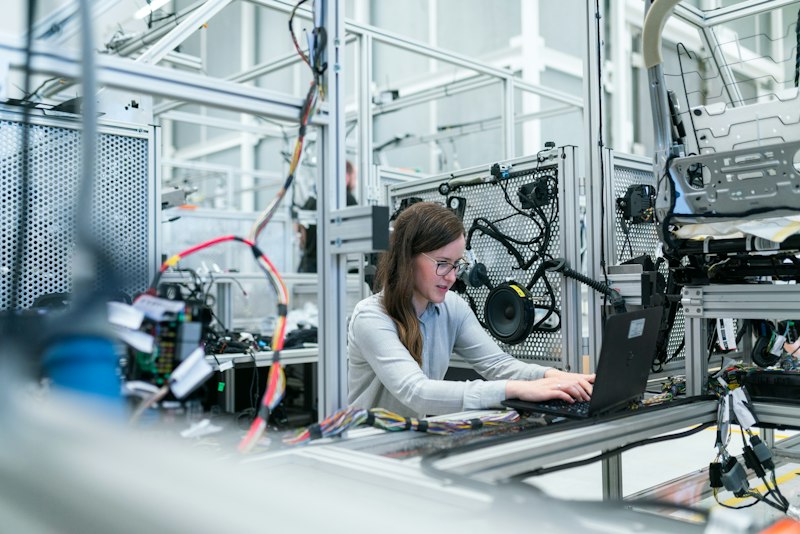
*China's EV component ecosystem — millions of precision motors, sensors, and actuators — has become the backbone of its humanoid robot supply chain*
The cost trajectory tells the story. In 2023, a basic humanoid robot platform from a Chinese manufacturer cost roughly $85,000. By 2025, Unitree's average price had dropped to $25,000. The R1 at $5,900 represents a new floor — not yet profitable, but designed to build market share and data feedback loops. Industry analysts expect the $20,000 threshold to be crossed by 2027–2028, at which point humanoid robots become economically competitive with human labor for a wide range of repetitive tasks.
| Component Category | Primary Chinese Suppliers | EV Crossover? | Cost Trend (2023→2026) |
|---|---|---|---|
| Precision motors & actuators | Estun, Inovance, Siasun | Yes — EV steering/drivetrain | -40% |
| LiDAR & vision sensors | Hesai, RoboSense, DJI Livox | Yes — autonomous vehicles | -35% |
| Battery packs & BMS | CATL, BYD, EVE Energy | Yes — EV batteries | -25% |
| Control chips (mid-range) | Horizon Robotics, Black Sesame | Partial — ADAS chips | -20% |
| AI compute (high-end) | Huawei Ascend, Biren | Emerging — AI training | Flat (supply constrained) |
| Structural alloys | China Zhongwang, Nanshan | Partial — lightweighting | -15% |
*Sources: Company disclosures; SVRC Research China Robotics Report 2026; industry interviews.*
The Money Flood: How Capital Shaped the Race
Production lines do not expand on engineering ambition alone. They need capital — and in 2026, capital has been flooding into China's humanoid robot sector at unprecedented velocity.
In the first quarter of 2026 alone, humanoid and embodied intelligence companies raised 68.1 billion RMB (approximately $9.5 billion), exceeding the total for all of 2025. The funding is not concentrated in a few headline deals. It is distributed across the entire stack — from full-stack robot makers to component suppliers to AI model companies building the "brains" that control robot bodies.
Some of the largest rounds:
- TARS (Itashi Zhihang): $455 million Pre-A round in April 2026 — the largest single Pre-A in Chinese embodied intelligence history. TARS is building massive training datasets (targeting 1 million hours of visual-action data) and world models for robot control.
- Ziliang Robot: ~$2 billion B round, led by Xiaomi and Sequoia China, with previous investments from ByteDance, Meituan, and Alibaba. The company is the only embodied intelligence startup to have raised from all four of China's internet giants.
- Tianji Intelligence: $1 billion B/B+ round, led by Hillhouse and Meituan, for core components (MEMS sensors, integrated joints).
- Critical Point: Unicorn status at >$1 billion valuation for dexterous hands — a component-level company.
- Pudu Robotics: The company building delivery and cleaning robots is expanding into humanoids with its PUDU D9, backed by a factory capable of 100,000 units annually.
The state is playing an active role. The National AI Industry Investment Fund, established in 2024, is accelerating deployment. Local governments — particularly Shanghai, Beijing, and Shenzhen — are offering direct subsidies for robot purchases, factory construction, and R&D. The Beijing E-Town (Yizhuang) district has set a target of 10,000 embodied intelligence robots deployed by end of 2026.
| Period | Embodied Intelligence Funding (RMB) | Notable Rounds | Key Investors |
|---|---|---|---|
| 2024 Full Year | ~200 billion | 200+ deals | Mixed VC + state funds |
| 2025 Full Year | ~578 billion | 315 deals | Peak late-stage growth |
| 2026 Q1 Only | 681 billion | 100+ deals | Exceeds 2025 total |
| 2026 Jan–Jun (est.) | ~1,200 billion | 200+ deals | Industrial capital dominant |
*Sources: IT Juzi; China Venture Research; company announcements. 2026 figures estimated through June.*
What 100,000 Robots Actually Means
To appreciate the significance of the 100,000-unit milestone, consider what it enables that smaller volumes cannot.
Data flywheels. Every robot deployed in a real environment generates data — video of tasks attempted, sensor readings of successful and failed grasps, locomotion patterns across varied terrain. At 1,000 units, this data is scientifically interesting but statistically thin. At 100,000 units, it becomes a training corpus that can fundamentally improve the next generation of robot AI. AgiBot's open-source strategy — releasing datasets and models to the developer community — is partly designed to accelerate this flywheel.
Cost gravity. Manufacturing cost curves are nonlinear. The jump from 1,000 to 10,000 units typically reduces costs by 30–40%. The jump from 10,000 to 100,000 can cut costs in half again. This is why Michael Tam's prediction of 20–30% annual cost declines is credible — and why the $20,000 humanoid by 2028 is not fantasy.
Standardization. At small volumes, every robot is essentially custom-built. At 100,000 units, standardization becomes mandatory — standardized joints, standardized software interfaces, standardized safety protocols. In February 2026, China's MIIT released the first national "Humanoid Robot and Embodied Intelligence Standard System," establishing six pillar standards covering neuromorphic computing, safety, and ethics. Standardization is both a prerequisite and a consequence of mass production.
Labor market effects. China has 285 million manufacturing workers. Humanoid robots will not replace them overnight — the 100,000 units planned for 2026 represent a tiny fraction of the workforce. But they will begin displacing humans in the most dangerous, repetitive, and physically demanding roles: welding in confined spaces, toxic material handling, 24-hour inspection rounds. The government is explicit about this goal. The "Modular Resonance" initiative — pairing humanoid robots with human workers on the same production lines — is designed to ease the transition.

*The data flywheel: every robot deployed becomes a sensor network, generating training data that improves every subsequent robot*
The View from the Competitors
China's dominance is not uncontested. The United States retains leadership in AI software, and several American companies are pursuing humanoid strategies with significant resources.
Tesla remains the most watched. Optimus Gen 3, if it achieves its production targets, could ship 15,000–35,000 units in 2026 — a substantial number, though still far below Chinese volumes. Tesla's advantage is vertical integration: it can leverage its automotive supply chain, its AI training infrastructure, and its massive balance sheet. Its disadvantage is that it is trying to build a general-purpose robot from day one, a harder problem than the task-specific approach favored by Chinese manufacturers.
Figure AI, backed by OpenAI and Microsoft, focuses on warehouse logistics — a narrower but more immediately commercializable domain. Its partnership with BMW for factory pilot programs suggests a path to industrial deployment, though production volumes remain small.
Boston Dynamics has demonstrated the most impressive physical capabilities, but its Atlas remains a research platform with no commercial production timeline. The company's ownership by Hyundai gives it automotive industry connections, but not the manufacturing scale of Chinese competitors.
1X Technologies (Norway/US) is targeting home service robots, a market segment that Chinese manufacturers have largely avoided so far.
The fundamental gap is production infrastructure. Chinese companies are not just building robots — they are building robot factories. Pudu Robotics operates a 40,000-square-meter facility with annual capacity of 100,000 units. Unitree's planned IPO will fund expansion to 75,000 humanoid and 115,000 quadruped units. AgiBot's "order-driven flexible production" system can triple output in three months. No American or European competitor has comparable manufacturing scale.
| Dimension | China | United States | Europe |
|---|---|---|---|
| 2025 Humanoid Shipments | ~18,000 (75% of global) | ~1,000 | ~200 |
| 2026 Production Target | 100,000+ | 15,000–35,000 (Tesla est.) | ~1,000 |
| Average Unit Price | $13,500–$80,000 | Not yet commercial | Not yet commercial |
| Supply Chain Integration | 90%+ domestic components | Dependent on Asian suppliers | Dependent on Asian suppliers |
| Policy Support | Direct subsidies, state procurement | Limited; DARPA grants | Regulatory framework focus |
| Key Advantage | Manufacturing scale + cost | AI software + capital | Safety standards + research |
*Sources: Omdia; TrendForce; company disclosures; SVRC Research.*
The Road Ahead: From 100,000 to a Million
If 100,000 units is the threshold that separates prototypes from products, what comes next? Industry projections suggest the path to a million units by 2030 is plausible, though not guaranteed.
Goldman Sachs projects global humanoid robot shipments of approximately 1.4 million by 2035 — a 70-fold increase from 2025 levels. Their models assume continued cost reductions, expanding application scenarios, and regulatory acceptance.
The near-term challenges are real. Humanoid robots still struggle with tasks that humans find trivial: opening a door with a round knob, picking up a crumpled piece of paper, navigating a cluttered room. Battery life remains limited — most units operate for 2–4 hours before requiring recharge or battery swap. And the "general purpose" promise remains largely unfulfilled; today's humanoids excel at narrow, repetitive tasks in controlled environments, not the adaptable assistance that science fiction promises.
But the trajectory is clear. Every month, the gap between demonstration and deployment narrows. Every quarter, another factory deploys its first humanoid workforce. Every year, the unit cost drops another 20–30%.
At the 2026 WAIC conference opening July 17 in Shanghai, over 200 companies in the embodied intelligence and smart computing tracks will showcase their latest products. The event will feature humanoid robots, dexterous hands, AI-powered exoskeletons, and "AI agent smartphones." For visitors walking the exhibition floor, the sheer density of physical AI will be overwhelming — and for competitors watching from abroad, it will be a sobering reminder of how fast China has moved.
The 100,000th humanoid robot produced in China in 2026 will not be celebrated with a factory banner. By the time that unit rolls off the line, production will have become routine. The milestone will pass unnoticed by the workers who assemble it, the engineers who program it, and the managers who ship it. That ordinariness is the point. When a technology becomes boring, it has won.
Social Voices
知乎 (Zhihu)
"一百台是新闻,一千台是噱头,一万台是产业,十万台是基础设施。2026年这个节点,中国机器人行业终于从PPT走到了资产负债表。"
*"One hundred units is news. One thousand is hype. Ten thousand is an industry. One hundred thousand is infrastructure. In 2026, China's robotics sector has finally moved from PowerPoint to the balance sheet."*
小红书 (Xiaohongshu)
"去WAIC看了一圈,宇树的机器人居然能后空翻了!但最让我震惊的是价格,R1只要不到四万人民币,比我男朋友的摩托车还便宜……"
*"Went to WAIC and watched Unitree's robot do a backflip! But what shocked me most was the price — the R1 costs less than 40,000 RMB, cheaper than my boyfriend's motorcycle..."*
微博 (Weibo)
"有人担心机器人抢工作,但看看工厂里那些焊接岗位,40度高温、有毒气体、每天站12小时,这种工作被机器人替代难道不是进步吗?"
*"Some people worry robots will take jobs, but look at welding positions in factories — 40-degree heat, toxic fumes, standing 12 hours a day. Is it really progress if robots DON'T replace this work?"*
Twitter/X
"China shipping 100K humanoid robots in 2026 while the US is still debating AI safety letters. The gap isn't in algorithms — it's in execution."
豆瓣 (Douban)
"优必选Walker S在比亚迪工厂的视频看了,动作确实还有点僵硬,但它能连续工作8小时不换班。制造业的逻辑很简单:能用、便宜、不坏,就够了。"
*"Watched the video of UBTECH's Walker S at BYD's factory. The movements are still a bit stiff, but it can work 8 hours straight without a shift change. Manufacturing logic is simple: usable, cheap, reliable. That's enough."*
GitHub
"AgiBot open-sourced their training datasets. That's the real competitive moat — not the hardware, but the data flywheel. Western companies guarding their datasets like dragons while Chinese firms feed the open-source ecosystem. Interesting strategic divergence."
Related Articles:
- China's AI Terminal Revolution: Smart Devices and Humanoid Robots Overtake the Old World
- Unitree Robotics' IPO: China's Humanoid Robot Sector Goes Public]
- WAIC 2026: Global AI Diplomacy in Shanghai
- LingSheng's Bet Against GPUs: How China's CPU-Only Supercomputer Could Rewrite AI]
Editor at AI in China. Tracking Chinese AI companies, funding rounds, and the technologies reshaping global tech. More about me.