China's Green AI Computing Revolution: How Inner Mongolia Built the World's Largest Sustainable Intelligence Factory
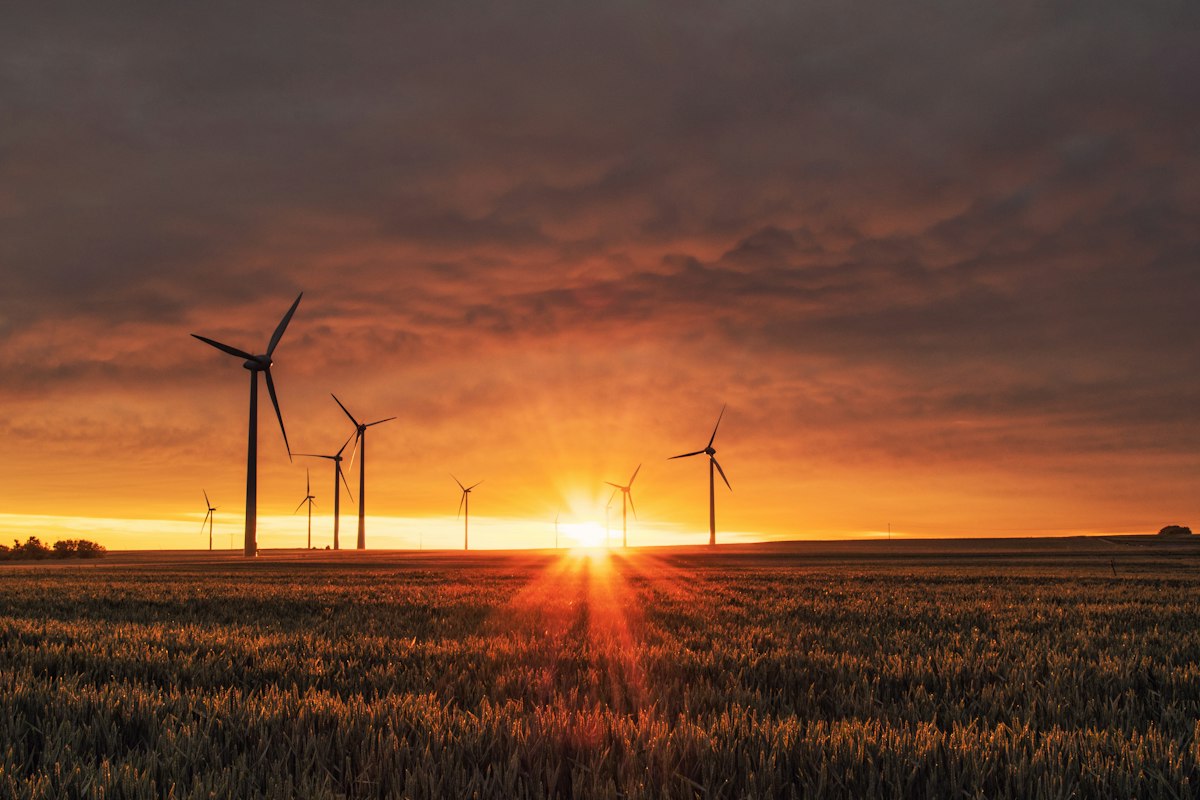
*Inner Mongolia's wind-swept grasslands now power some of the world's most advanced AI computing infrastructure—at a fraction of the carbon cost of Western data centers. (Image: Unsplash)*
On the morning of August 22, 2026, a conference hall in Hohhot—the capital of China's Inner Mongolia Autonomous Region—filled with an unusual mix of attendees. There were executives from ByteDance's Volcano Engine cloud division, engineers from AI chipmaker Cambricon, representatives from China Telecom, and officials from the National Development and Reform Commission. Outside, the grasslands of the Mongolian plateau stretched to the horizon, dotted with wind turbines that had been spinning since before dawn, harvesting one of the region's most abundant natural resources: wind.
By the time the 2026 Green Computing Power (Artificial Intelligence) Conference concluded, the numbers on the signed contracts told a story that would have seemed implausible just three years earlier. ¥186.46 billion ($27.49 billion) in new project investments. Twelve major deals spanning green intelligent computing centers, token factories, and computing-power manufacturing. A national video large-model computing base inaugurated. And perhaps most significantly, a comprehensive digital services export platform launched to connect China's green computing resources with the global AI market.
The conference was the fourth annual gathering of its kind. But 2026 felt different. This was no longer a regional showcase for Inner Mongolia's renewable energy advantages. It was a declaration that China had solved one of the most consequential challenges facing the global AI industry—how to build massive computing infrastructure without destroying the climate—and was now preparing to export that solution to the world.
The implications extend far beyond environmental virtue. They touch the fundamental economics of artificial intelligence, the geopolitics of digital infrastructure, and the question of who will control the computational layer of the 21st century.
The Numbers: Scale That Defies Intuition
To understand what has been built in Inner Mongolia, it helps to start with the physical reality of the infrastructure. The Horinger New Area in Hohhot—a district that barely registered on maps a decade ago—now hosts 62 operational computing centers with a combined capacity of 150,000 petaflops (PFlops). Of that total, 143,000 PFlops are dedicated to intelligent computing, the specialized workloads that train and run large AI models.
In neighboring Ulanqab, the operational computing capacity has reached 172,000 PFlops, with intelligent computing accounting for more than 95 percent of the total. Combined, the Inner Mongolia hub now operates approximately 315,000 PFlops of total computing power—including 297,000 PFlops of AI-specific capacity. That represents roughly one-seventh of China's entire national computing inventory.
For context, the world's most powerful supercomputer as of mid-2026, Frontier at Oak Ridge National Laboratory, delivers approximately 1.2 exaflops (1,200 PFlops) of peak performance. Inner Mongolia's AI computing capacity alone—just one region of one country—is roughly equivalent to 240 Frontier supercomputers running simultaneously. And this capacity is not experimental or reserved for academic research. It is production infrastructure, serving inference requests for hundreds of millions of users and training some of the world's largest open-weight models.
The energy economics are equally striking. Data centers in the Horinger cluster source more than 84 percent of their electricity from renewable sources—primarily wind and solar. In 2024, Inner Mongolia's installed wind and solar capacity exceeded 135 gigawatts, surpassing coal power for the first time in the region's history. The region now leads China in total renewable generation, new capacity additions, and power generated from clean sources.
For data center operators, this translates to a direct cost advantage. Electricity accounts for 60 to 70 percent of a data center's operating expenses. In Inner Mongolia, that electricity is not only green—it is cheap, stable, and increasingly insulated from the fossil fuel price volatility that has plagued Western operators. The average annual temperature of 7°C in Horinger also means natural cooling is available for half the year, further reducing energy consumption.
The result is an industrial ecosystem that the rest of the world has not yet fully comprehended: a computing hub that can train trillion-parameter models, serve inference to billions of users, and do so at a carbon intensity and cost structure that no Western data center cluster can currently match.
The Contrast: Two Models of AI Infrastructure
The story of AI infrastructure in 2026 is, in many ways, a tale of two approaches. Understanding what China has built requires understanding what the alternative looks like.
In the United States, AI computing infrastructure has emerged largely through market forces. Hyperscalers like Amazon, Microsoft, and Google have built massive data center campuses in regions selected primarily by real estate economics, tax incentives, and proximity to population centers. Northern Virginia's "Data Center Alley"—the world's largest concentration of data center capacity—draws most of its power from Dominion Energy, which in 2025 still generated approximately 44 percent of its electricity from natural gas and 17 percent from coal. The renewable transition is underway but incremental.
Microsoft's planned $3.3 billion AI data center in Mount Pleasant, Wisconsin, will draw up to 200 megawatts of power—enough to supply roughly 150,000 homes—from a grid that remains heavily dependent on fossil fuels. Google's data centers in Iowa run on significant wind power but still rely on carbon offsets and renewable energy certificates to claim carbon neutrality. The reality is that much of American AI computing runs on natural gas, with renewable penetration lagging well behind the marketing claims.
The fragmentation extends to planning. There is no national US strategy for aligning AI computing buildout with renewable energy deployment. Data center operators negotiate power purchase agreements where they can, buy renewable energy credits where they cannot, and lobby state utility commissions for rate relief. The result is a patchwork of varying carbon intensities, with the actual environmental footprint of an AI query depending heavily on which data center happens to serve it.
China's approach could not be more different. The "East Data West Computing" national strategy—formally launched in 2022 and now entering its fourth year of implementation—represents the world's first deliberate attempt to align massive digital infrastructure with renewable energy geography at a national scale. The logic is elegant in its simplicity: China's data centers and AI training clusters are concentrated in the western and northern regions where renewable energy is abundant and cheap, while the eastern coastal regions—where most users and enterprises are located—consume the computational output through high-speed fiber networks.
Inner Mongolia is the crown jewel of this strategy, but it is not alone. The Guizhou hub leverages hydroelectric power from the region's abundant rainfall and mountainous terrain. The Gansu and Ningxia hubs tap into massive wind and solar installations on the edge of the Gobi Desert. The Ningxia hub has built what it calls a "green data center corridor" where every new computing facility must meet strict renewable energy requirements.
The planning is centralized, the targets are binding, and the execution is coordinated across ministries, provincial governments, and state-owned enterprises. When the National Development and Reform Commission announced in March 2026 that China's daily AI token calls had surged from 100 billion in early 2024 to 140 trillion—a 1,400-fold increase in just over two years—it was already building the infrastructure to power that growth sustainably. The renewable energy capacity was approved first. The data centers followed.
The Strategy: From Resource Exporter to Intelligence Exporter
Inner Mongolia's transformation carries symbolic weight that extends beyond infrastructure metrics. For decades, the region was known primarily as a source of coal and rare earth minerals—raw materials extracted and shipped east to fuel China's industrial engine. The "East Data West Computing" strategy represents a deliberate inversion of that relationship. Inner Mongolia is no longer exporting coal. It is exporting intelligence.
The renewable energy that once might have been sold as electricity to distant grids is now consumed locally, converted through servers and GPUs into tokens, embeddings, and model weights that travel eastward as data rather than electrons. The grasslands that powered China's industrialization are now powering its cognitive infrastructure.
This is not merely a poetic reframing. It is a fundamental restructuring of regional economics. The 2026 conference signed projects with Volcano Engine, Cambricon, and China Telecom that will create thousands of high-skilled jobs in a region previously dependent on extractive industries. The Horinger Data Center Cluster has attracted not just data center operators but upstream equipment manufacturers—18 technology manufacturing projects covering servers, semiconductors, communication devices, sensors, and electronics.
Downstream, the applications are multiplying. Twenty companies are already using computing power from the cluster for smart mining, ecological monitoring, and industrial automation. Local authorities plan to deploy approximately 50 general-purpose and industry-specific large models by 2030, creating 100 typical AI application scenarios. The goal is not just to host other people's models but to develop regional AI capabilities that can be exported globally.
The digital services export platform launched at the conference accelerates this transition. The platform connects overseas developers with China's AI models and green computing resources, offering services including compliance assessment, computing-power scheduling, token measurement, cross-border settlement, and developer support. It represents an effort to shift China's AI export strategy from models and applications alone to the underlying computational infrastructure—a move that would make China not just an AI software exporter but a green AI utility.
The Economics: Why Green Computing Is Now a Competitive Weapon
For most of the history of cloud computing, energy costs were a line item to be managed, not a strategic differentiator. That changed in 2025 and 2026, when the explosive growth of AI model training and inference pushed electricity consumption to the forefront of competitive dynamics.
The International Energy Agency reported that data centers accounted for approximately 1.5 percent of global electricity consumption in 2024, with projections that this would more than double by 2030. But those projections assumed linear growth. The actual trajectory has been exponential. China's 140 trillion daily token calls in March 2026—up from 100 billion in early 2024—represent a demand curve that no energy planner had anticipated.
In this environment, the location and carbon intensity of computing power is no longer just an environmental concern. It is a direct determinant of cost structure, regulatory risk, and market access.
Consider the regulatory dimension. The European Union's AI Act, fully effective by mid-2026, includes provisions requiring transparency about the environmental impact of AI systems. The United States has not yet implemented federal AI energy regulations, but state-level requirements are proliferating. California's SB 1047 and similar legislation in other states increasingly require disclosure of training energy consumption. ESG-focused institutional investors are beginning to screen AI companies for their carbon footprints.
For Chinese AI companies operating green computing infrastructure in Inner Mongolia, these requirements represent an opportunity rather than a burden. A model trained in Horinger, where 84 percent of power comes from renewables, carries a fundamentally different carbon profile than one trained in a gas-powered facility in Texas or Virginia. As global markets begin to differentiate AI services based on environmental credentials, China's green computing advantage becomes a market access tool.
The cost advantage is equally significant. At current electricity rates in Inner Mongolia—heavily subsidized by abundant renewable supply—the marginal cost of training a trillion-parameter model is estimated to be 30 to 50 percent lower than in comparable US facilities running on grid power in Virginia or California. For an industry where the largest labs spend hundreds of millions of dollars on single training runs, this differential is not marginal. It is structural.
And the gap is widening. While US data center operators face rising power costs, grid interconnection delays, and community opposition to new fossil fuel plants, Inner Mongolia is adding renewable capacity faster than computing demand can absorb it. The region's 135 gigawatts of wind and solar in 2024 is projected to double by 2028. The constraint is no longer energy supply. It is how quickly server farms can be built to consume it.
The Global Implications: A New Geography of Intelligence
The 2026 Green Computing Power Conference was not merely a regional economic development event. It was a signal about how the global geography of artificial intelligence is being redrawn.
For the past decade, the implicit assumption in Silicon Valley and Washington has been that AI leadership is primarily a function of chip design, model architecture, and algorithmic innovation. The physical infrastructure—the data centers, the power grids, the cooling systems—was treated as a commodity that could be purchased wherever it was cheapest. China's strategy challenges that assumption fundamentally.
By integrating renewable energy deployment with AI computing infrastructure at a national scale, China has created a vertically integrated advantage that spans the entire AI value chain. The wind turbines in Inner Mongolia feed the data centers that train the models that power the applications that generate the revenue that funds the next generation of chips. Every link in that chain is coordinated by industrial policy, supported by state-backed financing, and aligned with national strategic objectives.
The digital services export platform launched at the conference extends this integration into the global market. If successful, it would allow developers anywhere in the world to access China's green computing infrastructure directly—to train models, run inference, and process data using renewable energy at a scale and cost that Western cloud providers cannot currently match. The platform's inclusion of compliance assessment and cross-border settlement suggests it is designed not just for Chinese companies going global but for foreign companies seeking green computing resources.
This is a fundamentally different model of AI globalization than the one envisioned in Washington or Brussels. Rather than exporting models and software, China would be exporting computing capacity itself—raw intelligence as a utility, delivered sustainably and cheaply. The analogy is not to Microsoft Azure or Amazon Web Services, which are fundamentally software platforms running on commodity infrastructure. It is closer to Saudi Aramco or Gazprom—state-coordinated resource giants that leverage geological advantages into global market power.
Whether this model appeals to global customers will depend on factors beyond cost and carbon intensity. Data sovereignty concerns, geopolitical risk, and trust in Chinese technology platforms remain significant barriers. But the economic logic is compelling, and the environmental credential is genuine. For companies in Southeast Asia, Africa, Latin America, and the Middle East—regions where AI adoption is accelerating but domestic computing infrastructure is limited—China's green computing export platform offers a credible alternative to Western cloud providers at a time when the Western providers themselves are struggling with energy costs and carbon footprints.
The Road Ahead: From Capacity to Ecosystem
The infrastructure that Inner Mongolia has built is remarkable. But infrastructure alone does not win the AI race. The next phase of China's green computing strategy will depend on whether it can translate raw capacity into a thriving ecosystem of model developers, application builders, and enterprise users.
The early signs are promising. ByteDance's Volcano Engine—one of the largest signatories at the August 2026 conference—has been rapidly expanding its cloud services for AI developers, offering not just compute but model hosting, fine-tuning, and deployment tools. Cambricon's participation suggests that domestic chip design and data center construction are increasingly integrated, reducing dependence on foreign silicon even as computing capacity expands.
The national video large-model computing base inaugurated during the conference points to sector-specific specialization. Rather than offering generic compute, Inner Mongolia is increasingly targeting specific AI workloads—video generation, multimodal training, industrial simulation—where its cost and carbon advantages can be most effectively leveraged.
The 2030 targets are ambitious: 50 large models, 100 application scenarios, and a fully integrated green computing ecosystem spanning hardware, software, and services. Whether these targets are met will depend on continued investment, talent availability, and the ability to navigate an increasingly complex global technology landscape.
But the foundation has been laid. In the span of four years, Inner Mongolia has transformed from a coal-producing backwater into the world's largest sustainable AI computing hub. The wind turbines that now dot its grasslands are spinning for a purpose that would have been unimaginable a decade ago: not to light factories or heat homes, but to train the neural networks that will define the next century of human civilization.
The rest of the world is still debating whether AI can be built sustainably. China has already built it—and is now preparing to sell that capability to whoever wants to buy it.
*Published on August 23, 2026. Data current as of August 22, 2026. Sources: 2026 Green Computing Power (AI) Conference official releases, Xinhua News Agency, China Daily, National Development and Reform Commission, International Energy Agency, Inner Mongolia Autonomous Region government disclosures.*
Editor at AI in China. Tracking Chinese AI companies, funding rounds, and the technologies reshaping global tech. More about me.