The Body Electric: How China's Embodied AI Push Is Building the Physical Internet
heroImage: "https://images.unsplash.com/photo-1485827404703-89b55fcc595e?w=1200"
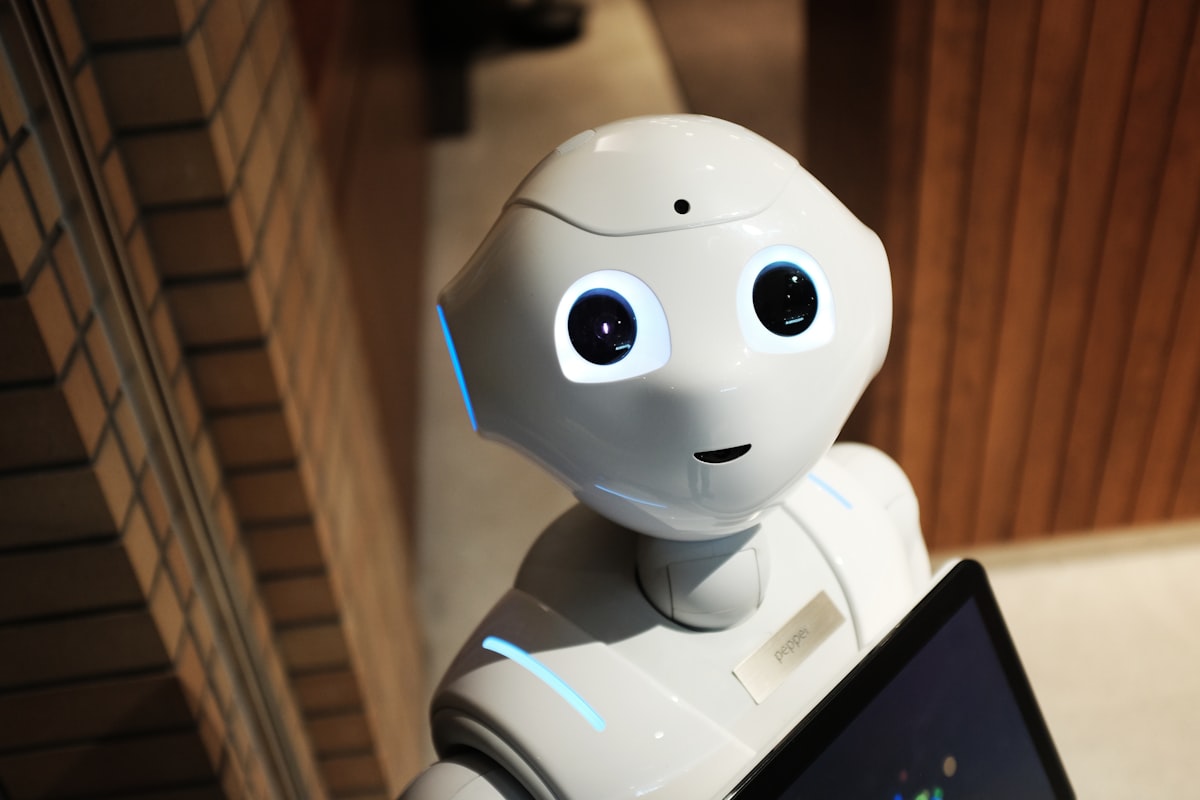
*Photo: A humanoid robot on a factory floor. China's embodied AI push represents the largest-scale transfer of artificial intelligence from digital to physical environments in history. Image: Unsplash*
The Floor Is Moving
At 9:47 AM on July 17, 2026, the main exhibition hall of the Shanghai World Expo Centre went silent for three seconds. Not because of a technical malfunction, but because 400,000 attendees collectively held their breath as a bipedal robot named SUYUAN—built by Shanghai Electric, standing 167 centimeters tall with 41 degrees of freedom—completed a precision connector insertion task on a replica automotive assembly line. The cycle time was 19 seconds. The success rate, the announcer noted, exceeded 99.9%.
This was not a demo. This was a declaration.
The 2026 World Artificial Intelligence Conference (WAIC) was unlike any previous edition. For the first time, "Embodied Intelligence" was elevated as one of two core technology tracks alongside AI computing power. Over 1,100 companies showcased more than 3,000 exhibits, including 300 global debuts. But the robots were not dancing for entertainment this year. They were working. A 1:1-scale "factory floor demonstration zone" replicated real manufacturing environments where humanoids carried out actual production-line tasks—loading, unloading, sorting, inspecting, and assembling.
Six weeks later, on August 29, 2026, the U.S. Federal Communications Commission announced a ban on imports of new Chinese-made humanoid and quadruped robots, citing security concerns. The timing was not coincidental. Washington had seen what Shanghai displayed, and the implications were unmistakable: China had moved its artificial intelligence competition with the United States from chatbots and benchmarks to the physical world.
This is the story of how China is building what might be called the physical internet—an infrastructure layer where AI does not merely process information but manipulates matter. And it is doing so with a speed, scale, and systemic coherence that has no parallel in Western technology policy.
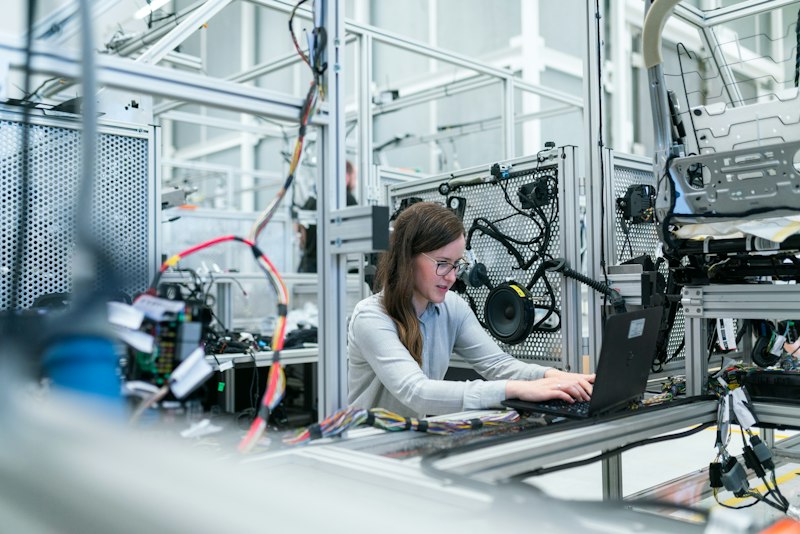
*Photo: Industrial robotics in action. China's embodied AI strategy leverages an existing base of 2 million operational industrial robots—4.5x more than Japan, the world's second-largest market. Image: Unsplash*
The Policy Architecture: Why This Time Is Different
China's push into embodied AI is not a startup-driven phenomenon that regulators are scrambling to understand. It is a state-directed industrial transformation that has been architected from the top down, with the full machinery of Chinese industrial policy behind it.
The foundation was laid in March 2025, when embodied intelligence was first named a "key future industry" in China's Government Work Report. President Xi Jinping has repeatedly stressed that cultivating future industries is essential to maintaining China's "strategic initiative" in science and technology. But the decisive document is the 15th Five-Year Plan (2026–2030), China's overarching policy blueprint, which cements embodied AI among the top-10 "new industries and new tracks."
The plan calls for coordinated build-out of large-scale training platforms, AI models and algorithms, core components, and key technologies. Humanoid robots are explicitly listed as embodied-AI products for "accelerated upgrades and deployment." This is not aspirational language. It is a binding directive that cascades through thousands of subordinate sectoral and regional plans, each mandated to align with the central objectives.
The financial architecture is equally striking. A roughly $138 billion national "guidance" fund for AI and advanced technology has been established, with additional commitments from provincial governments. Shanghai, Beijing, and Hangzhou have all set up innovation centers and pilot testing platforms. Shanghai specifically subsidizes up to 30% of project costs or discounts humanoid-robot purchases for qualifying enterprises.
| Policy Instrument | Detail | Year |
|---|---|---|
| 15th Five-Year Plan | Embodied AI named top-10 future industry; humanoid robots listed for accelerated deployment | 2026 |
| Government Work Report | Embodied intelligence first named "key future industry" | 2025 |
| National Guidance Fund | ~$138 billion for AI and advanced technology | 2025–2026 |
| HEIS 2026 Standard System | First comprehensive national standard for humanoid robots and embodied AI (120+ institutions involved) | Feb 2026 |
| MIIT Real-Scene Training Initiative | Target: 10,000+ humanoid robots in commercial use by end of 2026 across 100+ use cases | Jun 2026 |
| Shanghai Subsidy Program | Up to 30% project cost subsidy or purchase discounts for humanoid robots | 2026 |
| Hangzhou Pilot Base | National Pilot Base for Embodied AI Applications established | 2026 |
| US FCC Import Ban | Ban on new Chinese humanoid and quadruped robot imports | Jul 29, 2026 |
*Table 1: The policy architecture of China's embodied AI push. Unlike Western innovation models that rely primarily on venture capital and market forces, China's approach combines central planning, massive state funding, and regulatory standardization. Data: MIIT, State Council, APCO Worldwide, RobotToday.*
What distinguishes this from previous Chinese industrial plans is the integration mechanism. The Ministry of Industry and Information Technology (MIIT) and the State-owned Assets Supervision and Administration Commission (SASAC) jointly issued a circular in June 2026 launching the "Humanoid Robot and Embodied AI Real-Scene Training Special Action." This initiative targets key scenarios across industrial, special, and service sectors, with an integrated approach to constructing real-scene training spaces, fostering collaborative innovation syndicates, and validating real-world deployments.
The goal is not merely to build robots. It is to accumulate high-quality, real-world sensory-motor data—the critical input that physical AI requires but that virtual simulation cannot adequately provide. As one analyst put it: "Digital AI agents have made tremendous strides in virtual environments. Physical embodied agents still face a severe bottleneck: the scarcity of high-quality, real-world data. This policy addresses the core data drought in physical AI."
The Numbers: A Market Transforming at Velocity
The statistics of China's embodied AI expansion are difficult to process without context. Let us establish that context.
In 2025, global humanoid robot installations reached approximately 16,000 units. China accounted for more than 80% of those installations. The country already had an operational stock of roughly 2 million industrial robots—approximately 4.5 times more than Japan, the world's second-largest market, and representing roughly half the global total.
In the first half of 2026, global humanoid robot shipments surged 272% year-over-year to 19,100 units. China again dominated, with two companies—AgiBot and Unitree—accounting for approximately 75% of global shipments.
| Metric | Figure | Source |
|---|---|---|
| Global humanoid robot installations, 2025 | ~16,000 units | Counterpoint Research |
| China's share of 2025 installations | ~80% | Counterpoint Research |
| China industrial robot operational stock | ~2 million units (~50% global total) | IFR World Robotics 2025 |
| Global shipments 1H 2026 | 19,100 units (+272% YoY) | SAG Smart Analytics |
| AgiBot 1H 2026 shipments | ~8,400 units (44% global share) | SAG Smart Analytics |
| Unitree 1H 2026 shipments | ~5,900 units (31% global share) | SAG Smart Analytics |
| AgiBot total units produced (Jun 2026) | 15,000+ units | Pandaily / MIR DATABANK |
| Unitree cumulative production (Mar 2026) | ~11,000 units | Pandaily |
| China humanoid robot manufacturers | 140+ domestic companies | RobotToday / HEIS 2026 |
| Humanoid robot models on market | 330+ product models | RobotToday / HEIS 2026 |
| Unitree G1 price point | $16,000 ($17,990 on Amazon US) | Unitree / Curionic |
| Unitree R1 AIR price point | $4,900 | Unitree |
| Projected global market size 2035 | $50.27 billion (from $5.41B in 2026) | MarketsandMarkets |
| China target: commercial humanoid units by end 2026 | 10,000+ units | MIIT / APCO Worldwide |
*Table 2: The quantitative landscape of China's embodied AI market. The scale of production and deployment already exceeds Western competitors by an order of magnitude. Data: Counterpoint Research, SAG Smart Analytics, IFR, MarketsandMarkets, MIIT, Pandaily.*
The growth trajectory is equally striking. TrendForce projects that China's humanoid robot output will surge 94% in 2026, with Unitree and AgiBot together capturing nearly 80% of total shipments. Unitree's IPO application—approved in June 2026 with a target of approximately $610 million—would help reset industry valuations and improve financing conditions across the supply chain. The company has committed to expanding capacity to 75,000 humanoid robots and 115,000 quadruped robots annually.
AgiBot's production scale increased from 1,000 units in 2025 to 5,000 units, then doubled to 10,000 units within just three months—a ramp that would be inconceivable without the standardized supply chains and flexible manufacturing ecosystems that China has built around electric vehicles, batteries, and precision electronics.
The price dynamics are perhaps the most disruptive element. Unitree's G1 at $16,000 demonstrated that a capable, developer-ready biped could ship for less than most enterprise software contracts. The R1 AIR at $4,900 pushed that floor even lower. Morgan Stanley estimates that building a comparable robot without Chinese components would nearly triple actuator costs alone, from about $22,000 to $58,000—making price parity with Western manufacturing essentially impossible at current volumes.
The Players: A Duopoly and Its Challengers
China's embodied AI landscape is consolidating around two dominant players, with a tier of specialized competitors nipping at their heels.
AgiBot (Zhiyuan Robotics): The Volume King
AgiBot is, by shipment volume, the single most important humanoid robotics company in the world that most Western coverage ignores. Ranked number one globally in 2025 humanoid shipments by Omdia at 5,168 units, AgiBot overtook Unitree in the first half of 2026 to capture 44% of global shipments—approximately 8,400 units, up 562% year-over-year.
The company's flagship AgiBot A2 packs 49 degrees of freedom—more than any comparable platform—with 200 TOPS of onboard compute and a 10 kg dual-arm payload. It is backed by BYD and Hillhouse Capital, and its deployments are already generating measurable industrial value. At Longcheer Technology in Nanchang, the AgiBot G2 handles precision loading and unloading at multimedia integrated test stations with a 99.9% success rate, processing 310 units per hour with a 19-20 second cycle time. The line integration took 36 hours. The robot produces approximately 3,000 units per shift and operates 24/7 with downtime below 4%.
BYD's role is critical. The automaker has committed to deploying 20,000 humanoid units in 2026 (from a 2025 base of 1,500), and AgiBot is the primary beneficiary. Having one of China's largest manufacturers as both investor and customer creates a data flywheel: real-world deployment data flows back into training, improving capability, justifying expanded deployment.
Unitree: The Price Disruptor
Unitree's most important contribution to the humanoid market is not any specific robot—it is what its pricing proved is possible. The G1 at $16,000, listed on Amazon US at $17,990, demonstrated that a capable biped could ship for less than a mid-range sedan. The company shipped 5,500+ units in 2025—more than every Western competitor combined—and is targeting 10,000 to 20,000 units in 2026.
Unitree's IPO, approved in June 2026 for China's STAR market with a ~$610 million target, is significant because it validates the unit economics. A company cannot go public on a story about $16,000 robots if the margins aren't there. The prospectus reveals that in 2025, humanoid robot revenue surpassed quadruped revenue for the first time, accounting for over 51% of total revenue, with combined gross margins across both segments reaching 60%.
However, Unitree's deployment profile reveals the market's immaturity. Through Q3 2025, more than 70% of Unitree's humanoid robot revenue came from research and education customers, with industrial applications only 9%. Most shipped robots did not enter factory work—they went to labs, universities, and developers. Unitree is a platform first, a factory tool second.
UBTECH: The Enterprise Proven
UBTECH occupies a different position. Its Walker S2 has the most structured enterprise support among Chinese platforms, with documented deployments at BYD, NIO, and Foxconn. The company is publicly listed in Hong Kong (since 2022) and offers a hot-swappable battery system specifically designed for continuous industrial operation. In 2025, UBTECH recorded RMB 821 million in humanoid revenue from 1,079 full-size units—making it #1 by revenue even if not by volume.
| Company | Flagship Model | 1H 2026 Shipments | Global Share | Key Differentiator | Key Deployments |
|---|---|---|---|---|---|
| AgiBot | A2 / G2 | ~8,400 | 44% | 49 DOF, 200 TOPS, 10kg dual-arm payload | BYD, Longcheer Technology, SAIC Motor |
| Unitree | G1 / H2 / R1 | ~5,900 | 31% | Price disruption ($16K G1, $4.9K R1 AIR) | Research labs, education, developer platforms |
| UBTECH | Walker S2 | ~800 (2025 full year) | ~5% (2025) | Enterprise support, hot-swappable battery, public company | BYD, NIO, Foxconn |
| Leju | Various | ~800 (2025) | ~5% (2025) | Education and consumer focus | Schools, retail |
| Tesla | Optimus | ~800 (2025) | ~5% (2025) | Automotive integration potential | Internal Tesla factories |
| Figure AI | Figure 02 | "A few hundred" | <3% | Western enterprise leader | Limited commercial trials |
*Table 3: Global humanoid robot vendor comparison. The Chinese duopoly of AgiBot and Unitree controls 75% of global shipments, while Western competitors remain in the hundreds of units. Data: SAG Smart Analytics, Counterpoint Research, Curionic, Pandaily.*
The contrast with Western competitors is stark. Tesla's Optimus and Figure AI's Figure 02 each delivered "a few hundred or less" units in 2025. Agility Robotics' Digit operates at Schaeffler's South Carolina facility inside a Plexiglas cage for federal compliance. The Western approach prioritizes safety certification and gradual deployment; the Chinese approach prioritizes scale, data accumulation, and iterative refinement in real environments.
The Standards Play: Writing the Rules
On February 28, 2026, at Beijing's YiZhuang innovation district, MIIT unveiled a document that may prove as consequential for global robotics as the GB/T charging standard was for electric vehicles: the Humanoid Robot and Embodied Intelligence Standard System (2026 Edition)—HEIS 2026.
Drafted collaboratively by more than 120 research institutions, manufacturers, and industry end-users under the newly formed MIIT Technical Committee (TC08), this is China's first comprehensive national standard framework covering the full industrial chain and complete lifecycle of humanoid robots and embodied AI. It spans technical interfaces, safety requirements, testing protocols, and interoperability standards.
The strategic logic mirrors China's EV success. In the early days of electric vehicles, the world faced charging standard fragmentation: Japan pushed CHAdeMO, Europe supported CCS, and China developed GB/T. As Chinese domestic market share grew rapidly, the unified GB/T standard took off globally. Today, the humanoid robot industry faces identical fragmentation: every manufacturer uses different dexterous hand interfaces, proprietary joint motor control protocols, and incompatible perception module communication methods. HEIS 2026 is Beijing's bid to prevent that fragmentation from solidifying—and to ensure that when global standards converge, they converge on Chinese terms.
| Standard Domain | HEIS 2026 Coverage | Implication |
|---|---|---|
| Technical Interfaces | Unified dexterous hand protocols, joint motor control standards | Prevents vendor lock-in; enables component interoperability |
| Safety Requirements | Lifecycle safety for human-robot collaboration | Accelerates deployment by reducing site-specific safety negotiations |
| Testing Protocols | Standardized validation for physical performance | Creates measurable quality floor; enables certification exports |
| Perception Modules | Compatible communication standards for sensors | Reduces integration cost; lowers barrier to entry for new players |
| Software Architecture | Reference frameworks for embodied AI control | Enables model portability across hardware platforms |
| Data Formats | Standardized training data schemas for real-world scenarios | Facilitates data sharing and federated learning |
*Table 4: HEIS 2026 standard framework domains. By establishing national standards before global standards solidify, China is positioning to export not just robots but the regulatory framework that governs them. Data: RobotToday, MIIT.*
As China's market scale and shipment volumes continue to grow, its domestic standards could carry into global norms—positioning Beijing to help write the rules for an industry it increasingly dominates. This is the same playbook that made Chinese EV charging infrastructure the de facto standard across Southeast Asia and increasingly in Europe.
The Factory Floor: Where Theory Meets Reality
The most revealing data about China's embodied AI push is not the number of robots shipped. It is what those robots are actually doing.
At Longcheer Technology's consumer electronics line in Nanchang, the AgiBot G2 operates at a 99.9% success rate on precision loading and unloading tasks, with throughput of 310 units per hour. The robot handles tablets, places them into test jigs with millimeter-level precision, and sorts finished versus defective units. Line integration took 36 hours. AgiBot demonstrated continuous operation exceeding 140 hours, and expansion to 100 robots is planned for Q3 2026.
Shanghai Electric's SUYUAN robot, with 41 degrees of freedom, is deployed for inspection, material handling, and assembly tasks. Its TUOYUAN wheeled humanoid handles multi-spec connector insertion, material sorting, and automotive sheet metal loading/unloading. The "Mermaid" bionic wheeled robot autonomously identifies buttons, knobs, and air switches, generating real-time operation paths.
But the reality is more nuanced than the press releases suggest. All current commercial deployments involve 1 to 3 fixed, repetitive tasks. General-purpose humanoids operating flexibly across multiple tasks remain in R&D. Battery runtime remains a constraint—Unitree's G1 operates for 2 hours per charge. Safety standards for humanoid robots working alongside people remain undeveloped globally, meaning each deployment negotiates its own safety perimeter.
| Deployment | Robot | Task | Performance | Location |
|---|---|---|---|---|
| Longcheer Technology | AgiBot G2 | Precision loading/unloading at test stations | 99.9% success, 310 units/hour, 19s cycle | Nanchang, China |
| BYD Assembly Lines | AgiBot A2 | Industrial automation, material handling | Scale: 20,000 units committed for 2026 | Multiple sites, China |
| Schaeffler | Agility Digit | Bearing component handling | 25-lb basket transfer; operates in safety cage | Cheraw, SC, USA |
| Toyota Motor Mfg | Agility Digit | Automotive parts handling | 7 units deployed | Woodstock, Ontario |
| Foxconn | UBTECH Walker S2 | Assembly line evaluation | Under evaluation for Houston, TX facility | Multiple sites |
| Shanghai Electric | SUYUAN | Inspection, material handling, assembly | 41 DOF, dual-battery hot-swap | Shanghai, China |
| Pharma Cleanroom | Various | Asset monitoring patrol | 312 hours logged, 47 assets monitored | Trial deployment |
*Table 5: Confirmed humanoid robot deployments in industrial settings, 2026. Chinese deployments outnumber Western counterparts by an order of magnitude, though Western deployments tend to be more heavily documented and safety-certified. Data: Pandaily, iiOT World, Assembly Magazine.*
The honest assessment is that humanoid robots in 2026 are where industrial robots were in the 1970s: capable of specific, bounded tasks, but not yet the general-purpose "universal factory helpers" that science fiction promises. The difference is the rate of iteration. China's scenario-driven innovation model—deploying robots in real-world settings to refine algorithms, lower costs, and accumulate data—creates a feedback loop that accelerates capability faster than laboratory-only development.
The Geopolitical Dimension: When Supply Chains Become Weapons
The embodied AI race is not merely technological or economic. It is increasingly geopolitical—and the weapons are supply chains and standards.
On July 29, 2026, the U.S. FCC announced a ban on imports of new Chinese-made humanoid and quadruped robots. The justification was security: concerns about data collection, remote access, and potential surveillance capabilities embedded in networked robotic systems. The practical effect was to protect domestic development by limiting Chinese model access in the U.S. market.
The ban is understandable from a security perspective. But it is also a recognition of strategic vulnerability. The United States does not currently have domestic humanoid robot manufacturing at scale. Tesla's Optimus and Figure AI's products exist in the hundreds of units. Agility Robotics' Digit operates in limited trials. The Chinese duopoly—AgiBot and Unitree—ships more robots in a month than all American competitors combined ship in a year.
| Dimension | China | Western Markets |
|---|---|---|
| 2025 share of global installations | ~80% | ~20% |
| Primary vendors at scale | AgiBot, Unitree, UBTECH, Leju | Agility Robotics, Boston Dynamics, Figure AI |
| Dominant commercial model | Direct sale + internal factory use | RaaS (Robots-as-a-Service) |
| Leading sectors | Automotive, consumer electronics, logistics | Electronics components, pharmaceutical monitoring |
| Price range (entry humanoid) | $4,900–$16,000 | $250,000+ (Digit); comparable platforms often $100K+ |
| Supply chain control | Domestic: batteries, actuators, sensors, assembly | Dependent on Chinese components for cost-effective production |
| Regulatory posture | Deployment-first, standards-follow | Safety-first, certification-heavy |
| State support | $138B guidance fund; 30% purchase subsidies | DARPA grants; limited direct industrial policy |
*Table 6: China vs. Western embodied AI deployment posture. The structural differences extend beyond technology to encompass commercial models, regulatory philosophy, and the role of state support. Data: Multiple sources compiled by iiOT World, APCO Worldwide.*
The deeper vulnerability is supply chain. China controls the actuator, battery, and sensor supply chains that all humanoid robots depend on. Morgan Stanley's analysis is blunt: building a comparable robot without Chinese components would nearly triple costs. This means that even if the U.S. bans Chinese robot imports, American robot companies still depend on Chinese supply chains for affordable production—unless they are willing to accept dramatically higher costs and lower volumes.
Meanwhile, China is building the rules of the road. The HEIS 2026 standard system, combined with the world's largest deployment base, creates a standards-setting advantage that compounds over time. As one policy analyst noted: "As China's market scale and shipment volumes continue to grow, its domestic standards could carry into global norms."
The parallel with 5G telecommunications is instructive. Huawei's technology was not merely competitive—it was embedded in standards that the rest of the world adopted. The result was that banning Huawei equipment became technically and economically costly for allied nations. China appears to be pursuing a similar strategy with embodied AI: build the largest deployment base, write the standards, and make alternative ecosystems economically unattractive.
The Digital-Physical Bridge: Why LLMs Matter for Robots
The embodied AI story is incomplete without understanding how China's frontier language models connect to physical robots. This is not merely about putting a chatbot in a metal body. It is about transferring the reasoning, planning, and generalization capabilities of large models into physical control systems.
The technical term is VLA—Vision-Language-Action models. These systems take visual input from cameras, process it through language-model reasoning, and output motor commands. AgiBot deploys in-house VLA models across its robot portfolio. Unitree has open-sourced its UnifoLM-VLA-0 model. UBTECH integrates proprietary enterprise software with hot-swappable battery systems for 24/7 operation.
The significance of Moonshot AI's Kimi K3 and DeepSeek's V4 Flash in this context is not merely their benchmark performance. It is that open-weight models of frontier capability can be fine-tuned for specific robotic control tasks without the licensing constraints or API costs of proprietary Western models. A factory deploying AgiBot robots can download Kimi K3's weights, fine-tune them on its specific assembly-line data, and deploy the resulting VLA model locally—without sending data to a third-party API, without per-token pricing, and without vendor lock-in.
| AI Model | Parameters | Open Weights | Relevance to Embodied AI |
|---|---|---|---|
| Kimi K3 | 2.8T (MoE) | Yes (Jul 28, 2026) | Largest open-weight model; can be fine-tuned for VLA tasks |
| DeepSeek V4 Flash | 284B (13B active) | Yes | Extreme efficiency; deployable on edge compute |
| Qwen 3.8-Max | 2.4T (95B active) | Planned | Strong agentic benchmarks; multimodal capabilities |
| GLM-5.2 | ~744B (~40B active) | Yes | Code and design optimization for robotic planning |
| Unitree UnifoLM-VLA-0 | N/A | Yes | Purpose-built for robot control; open-sourced |
| AgiBot VLA | N/A | No | Proprietary; optimized for industrial manipulation |
*Table 7: The connection between China's frontier LLMs and embodied AI. Open-weight models enable factories to fine-tune AI for specific robotic tasks without API dependency or data exfiltration. Data: Vendor releases, Artificial Analysis.*
This creates a domestic ecosystem effect that is difficult for foreign competitors to replicate. Chinese robot manufacturers have access to Chinese AI models trained on Chinese data, optimized for Chinese manufacturing scenarios, and deployable on Chinese hardware—all without cross-border data flows or foreign API dependencies. The result is a vertically integrated pipeline from model training to physical deployment that operates at a cost and speed advantage.
What Happens Next: Three Scenarios
The trajectory of China's embodied AI push will depend on how several variables interact: the pace of real-world deployment, the evolution of global standards, the durability of Western export controls, and the rate of improvement in general-purpose robotic capability.
Scenario A: The Physical Internet (Probability: 55%)
China successfully deploys 10,000+ humanoid robots in commercial use by end of 2026, accumulates sufficient real-world data to improve VLA models rapidly, and establishes HEIS 2026 as the basis for regional standards across Asia. By 2028, Chinese humanoid robots are standard equipment in factories across Southeast Asia, and the country dominates the global market as it does industrial robots today. Western competitors remain constrained by higher costs, slower deployment cycles, and limited data accumulation.
Scenario B: The Capability Wall (Probability: 30%)
General-purpose humanoid capability proves harder to achieve than current trajectories suggest. The gap between fixed-task performance and flexible, multi-task operation remains stubbornly wide. Battery life, safety certification, and edge-case handling become bottlenecks that slow deployment. China's advantage narrows to industrial niches where task specificity is acceptable, and the market fragments into specialized robots rather than general-purpose humanoids.
Scenario C: The Regulatory Divergence (Probability: 15%)
Western nations erect comprehensive barriers to Chinese robotics technology—extending beyond import bans to component restrictions, data localization requirements, and standards divergence. A bifurcated global robotics market emerges: Chinese standards and supply chains dominate Asia, Africa, and Latin America, while Western ecosystems develop independently at higher cost and lower scale. The result is a technological iron curtain in physical AI.
| Scenario | Probability | Key Driver | Global Outcome |
|---|---|---|---|
| A: Physical Internet | 55% | Data flywheel + standards export | China dominates global humanoid market |
| B: Capability Wall | 30% | General-purpose AI proves harder than expected | Market fragments into specialized niches |
| C: Regulatory Divergence | 15% | Comprehensive Western tech decoupling | Bifurcated global robotics standards |
*Table 8: Three scenarios for the evolution of China's embodied AI push. The most probable outcome is a gradual extension of current advantages into global market dominance, but significant uncertainty remains around general-purpose capability and geopolitical constraints.*
The base case—Scenario A—is the most probable because it extrapolates current trends without assuming fundamental barriers. China already dominates industrial robot installations. It already has the manufacturing ecosystem, the state funding, and the deployment philosophy. The question is not whether it can build robots, but whether it can make them general-purpose enough to justify the scale of investment.
The View from the Ground
What do the people actually building and deploying these systems think? We collected comments from Chinese social media and industry forums following WAIC 2026 and the FCC ban announcement.
@智能制造老王 (Smart Manufacturing Lao Wang, Weibo):
"去了WAIC三天,最大的感受不是机器人有多先进,而是场景有多真实。去年还在跳舞,今年已经在产线上拧螺丝了。这个迭代速度,国外同行看了估计睡不着。"
*Translation: "Spent three days at WAIC. My biggest takeaway wasn't how advanced the robots are—it was how real the scenarios are. Last year they were dancing; this year they're screwing bolts on production lines. Foreign competitors probably can't sleep after seeing this iteration speed."*
@机器人行业观察 (Robot Industry Observer, Zhihu):
"AgiBot和Unitree加起来占了全球75%的出货量,但这个数字背后有个问题:70%的Unitree机器人去了高校和研究所,不是工厂。真正的工业落地还需要时间。"
*Translation: "AgiBot and Unitree together account for 75% of global shipments, but there's a problem behind that number: 70% of Unitree robots went to universities and research institutes, not factories. Real industrial deployment still needs time."*
@硅谷归来看中国 (Returned from Silicon Valley, Looking at China, Xiaohongshu):
"美国FCC禁了中国人形机器人进口,表面上理由是安全,实际上是慌了。Tesla的Optimus还在PPT阶段,中国这边已经量产上万台了。这不是技术差距,是产业链差距。"
*Translation: "The US FCC banned Chinese humanoid robot imports. The stated reason is security, but they're actually panicking. Tesla's Optimus is still in PowerPoint stage, while China has already mass-produced tens of thousands. This isn't a technology gap—it's a supply chain gap."*
@投资看赛道 (Investing by Track, WeChat Moments):
"宇树科技IPO过会了,毛利率60%。很多人不理解机器人公司怎么能有这么高的毛利。答案是:中国的新能源车产业链。电池、电机、传感器,全部国产化,成本是美国同行的三分之一。"
*Translation: "Unitree's IPO was approved, with 60% gross margin. Many people don't understand how a robotics company can have such high margins. The answer: China's new energy vehicle supply chain. Batteries, motors, sensors—all domestic, at one-third the cost of American counterparts."*
@工厂数字化李工 (Factory Digitalization Engineer Li, Zhihu):
"我们在南昌产线上用了AgiBot的G2,99.9%的成功率确实 impressive。但说实话,只能做固定动作。换个产品型号就要重新编程。真正的通用机器人还远着呢。"
*Translation: "We use AgiBot's G2 on our Nanchang production line. The 99.9% success rate is genuinely impressive. But honestly, it can only do fixed movements. Change the product model and you need to reprogram. Truly general-purpose robots are still far away."*
@标准制定者 (Standard Setter, Professional Forum):
"HEIS 2026很多人看不上,觉得只是又一份官僚文件。但当年GB/T充电标准也是被这样看不起的,现在呢?全球电动车都在用中国标准。 人形机器人领域,历史会重演。"
*Translation: "Many people dismiss HEIS 2026 as just another bureaucratic document. But GB/T charging standards were dismissed the same way back then. Now? The whole world's EVs use Chinese standards. History will repeat in humanoid robotics."*
Conclusion: The Infrastructure Layer
The most common mistake in analyzing China's AI strategy is to frame it as a competition over models—who has the best LLM, the highest benchmark, the lowest price per token. This framing misses the deeper transformation underway.
China's embodied AI push is not about building better chatbots with metal bodies. It is about creating a new infrastructure layer—the physical internet—where artificial intelligence extends beyond information processing into material manipulation. The 15th Five-Year Plan does not treat humanoid robots as consumer gadgets or research curiosities. It treats them as "intelligent terminals" that diffuse AI across the economy, modernizing manufacturing, generating new growth engines, and building industrial resilience.
The numbers are already stark: 19,100 humanoid robots shipped in six months. 140+ domestic manufacturers. 330+ models. A $138 billion state fund. The world's first national standard system. A supply chain that triples competitor costs if they try to build without it.
But the most important number may be the simplest: 99.9%. That is the success rate of a Chinese humanoid robot on a real production line, handling real products, in a real factory, for 140 continuous hours. It is not science fiction. It is not a demo. It is a measurement.
The West is not losing the embodied AI race because its researchers are less talented or its entrepreneurs less ambitious. It is losing because China has built a production system that converts AI research into physical infrastructure faster than any other ecosystem on Earth—and it is doing so with a coherence of policy, funding, and industrial integration that has no Western equivalent.
The robots at WAIC 2026 were not dancing. They were working. And they were just getting started.
*Published: September 1, 2026 | Category: AI Business | Reading time: ~14 minutes*
Sources: APCO Worldwide; AgentUpdate.ai; Counterpoint Research; Curionic; Dealroom.co; iiOT World; International Federation of Robotics (IFR); MarketsandMarkets; MIR DATABANK; MIIT; Pandaily; RobotToday; SAG Smart Analytics; Shanghai Electric; SmartAnalyticsGlobal; TrendForce; Unitree Robotics; Xinhua; 36Kr.
Editor at AI in China. Tracking Chinese AI companies, funding rounds, and the technologies reshaping global tech. More about me.