China's AI Spending War: How Tencent's First Negative Cash Flow in 20 Years Signals a Trillion-Yuan Arms Race

At 4:00 PM on August 12, 2026, the conference room on the 38th floor of Tencent's Shenzhen headquarters fell silent. The CFO had just revealed a number that nobody in the room had seen in their careers: negative RMB 13.8 billion in free cash flow. For the first time in over twenty years, China's most profitable internet company was burning more cash than it was generating.
The culprit wasn't a failed acquisition or a regulatory fine. It was artificial intelligence.
Tencent's second-quarter capital expenditure had exploded to RMB 52.8 billion — a 176% year-over-year surge that shattered every analyst estimate. The company was spending nearly RMB 580 million per day on data centers, GPU clusters, and AI infrastructure. In just six months, Tencent's capex had exceeded its entire 2025 annual total.
But Tencent wasn't alone. Across China's tech landscape, the biggest companies were engaged in what can only be described as an all-out spending war. Alibaba was pouring RMB 676.78 billion into a single quarter. Baidu had boosted its capex by 201%. ByteDance, the unlisted giant, was reportedly planning to spend up to $70 billion — roughly RMB 475 billion — in 2026 alone.
The question echoing through boardrooms from Beijing to Hangzhou to Shenzhen isn't whether these companies can afford this spending. It's whether they can afford *not* to.
The Numbers That Shocked Wall Street
When Tencent released its Q2 2026 earnings, the headline revenue figure — RMB 204.8 billion, up 11% — was almost an afterthought. What dominated every analyst call, every headline, and every sell-side note was the capex number: RMB 52.78 billion, nearly triple the RMB 19.1 billion spent in the same quarter a year earlier and 65% higher than the already-elevated Q1 2026 figure.
The market's reaction was immediate and brutal. Tencent's Hong Kong-listed shares dropped 3% in the first trading session after the announcement. Investors weren't just reacting to the spending — they were grappling with the unprecedented sight of Tencent's free cash flow turning negative for the first time since the early 2000s.

*China's tech giants are shattering spending records as they race to build AI infrastructure. Image: Unsplash*
Yet the management team's message during the earnings call was unambiguous: this is only the beginning. Tencent explicitly warned that capex would rise further in the second half of 2026 as domestic AI chip supply ramps up and the company accelerates its buildout of training and inference clusters.
Alibaba, which reported its numbers days later, delivered an even more staggering figure: RMB 676.78 billion in quarterly capital expenditure, up 75% year-over-year. CEO Eddie Wu revealed that Alibaba's previously announced three-year, RMB 3,800 billion AI infrastructure plan had already seen RMB 1,900 billion deployed by the end of June — half the total commitment consumed in less than a year.
Baidu, often considered the laggard among the "BAT" trio, wasn't holding back either. Its Q2 capex hit RMB 11.4 billion, a 201% increase from the prior year. The company has spent over RMB 100 billion on AI since launching Ernie Bot in March 2023.
And then there's ByteDance — the private, unlisted giant that may be outspending all of them combined.
| Company | Q2 2026 Capex (RMB) | YoY Growth | H1 2026 Capex (RMB) | 2026 Full-Year Guidance |
|---|---|---|---|---|
| Alibaba | 676.78 billion | +75% | ~1,100 billion | ~1,500 billion (annualized) |
| Tencent | 527.84 billion | +176% | 847.2 billion | 1,300–1,500 billion |
| ByteDance | ~500 billion (est.) | +25%+ | ~1,000 billion (est.) | 2,000–4,759 billion |
| Baidu | 114 billion | +201% | ~200 billion (est.) | ~300 billion |
| Combined | ~1,818 billion | ~+100% | ~3,147 billion | ~5,100–7,059 billion |
*Sources: Company Q2 2026 earnings reports, Bloomberg, SCMP. ByteDance figures are estimates based on reported internal targets.*
ByteDance: The Elephant in the Server Room
The most jaw-dropping numbers in this spending war aren't coming from listed companies with transparent financial disclosures. They're coming from ByteDance, the TikTok parent that operates outside the glare of quarterly earnings reports.
According to Bloomberg, ByteDance is internally discussing raising its 2026 capital expenditure ceiling to $70 billion — approximately RMB 475.9 billion. If this figure materializes, ByteDance alone would be spending more than Alibaba, Tencent, and Baidu combined.
The company's spending has been on a vertical trajectory. From roughly RMB 80 billion in 2024, ByteDance's AI infrastructure budget more than doubled to around RMB 160 billion in 2025. The 2026 figure, even at the conservative end of reported ranges (RMB 2,000 billion), represents a further 25% increase from the already-massive 2025 baseline.
Where is all this money going? A detailed breakdown from industry analysts reveals the staggering scale of ByteDance's infrastructure ambitions:
| Spending Category | Estimated Budget (RMB) | Share of Total | Key Details |
|---|---|---|---|
| AI GPU / Server Procurement | 850 billion | ~43% | NVIDIA H200/GB200 clusters via Inspur; domestic chips for inference |
| Data Center Construction | 900 billion | ~45% | New facilities in Inner Mongolia, Xinjiang, Guangdong-Hong Kong-Macao |
| Networking / Storage / Optics | 250 billion | ~12% | High-speed optical modules, cluster interconnects |
| Total | 2,000 billion | 100% | Excludes R&D salaries and acquisition costs |
*Source: Industry analyst estimates compiled from Xueqiu and TrendForce reports.*
ByteDance's AI infrastructure serves as the backbone for its Doubao large language model, which has emerged as the most-used AI app in China with a 46.4% market share among standalone AI applications. The company's daily token processing volume crossed 120 trillion in March 2026 — a 1,000x increase from Doubao's launch in May 2024 and double the volume from just three months prior.
The Global Context: China vs. Silicon Valley
China's AI spending spree isn't happening in a vacuum. American tech giants are engaged in their own arms race, with Meta guiding 2026 capex to $125–145 billion and Microsoft targeting approximately $146 billion. Google, Amazon, and Oracle are similarly deploying record sums.
Yet the Chinese numbers stand out for their intensity relative to company size and profitability. While Meta and Microsoft are spending billions, they're doing so from positions of deep profitability and massive cash reserves. Tencent's negative free cash flow and ByteDance's reported 70% year-over-year profit decline in 2025 tell a different story — one of companies betting their near-term financial health on a long-term AI payoff.
| Company / Group | 2026 Capex Guidance (USD) | Primary Focus | Profitability Context |
|---|---|---|---|
| Meta | $125–145 billion | AI training clusters, Llama ecosystem | Highly profitable |
| Microsoft | ~$146 billion | Azure AI infrastructure, OpenAI partnership | Highly profitable |
| ~$75 billion | TPU clusters, Gemini infrastructure | Highly profitable | |
| Chinese Big Four | ~$110–160 billion (combined) | Domestic GPU clusters, self-developed chips | Mixed (Tencents FCF negative, ByteDance profits down) |
*Sources: Company guidance, Bloomberg, TrendForce. Chinese figures converted at ~7.25 RMB/USD.*
The global aggregate is staggering. TrendForce estimates that nine major cloud providers — including the four Chinese giants plus Google, AWS, Meta, Microsoft, and Oracle — will spend approximately $830 billion on capital expenditures in 2026, a 79% increase from 2025. The entire world's cloud infrastructure is being rebuilt for AI, and Chinese companies are determined not to be left behind.
Where the Money Goes: Inside the Infrastructure Buildout
The capital flowing into China's AI sector is being deployed across three primary battlegrounds: hardware infrastructure, model development, and application deployment.
Hardware Infrastructure consumes the largest share of spending — roughly 55–60% of total capex. This includes NVIDIA H200 and GB200 GPU clusters for training, domestic alternatives from Huawei's Ascend and Cambricon for inference workloads, server racks, cooling systems, and the data center real estate to house it all.
Tencent's management explicitly noted that the bulk of its Q2 capex went toward "AI-native business" — specifically, computing resources for model training, inference capacity, and the buildout of AI cloud services. The company is constructing massive training clusters while simultaneously deploying edge inference nodes to support real-time AI features across WeChat, QQ, and Tencent Cloud.
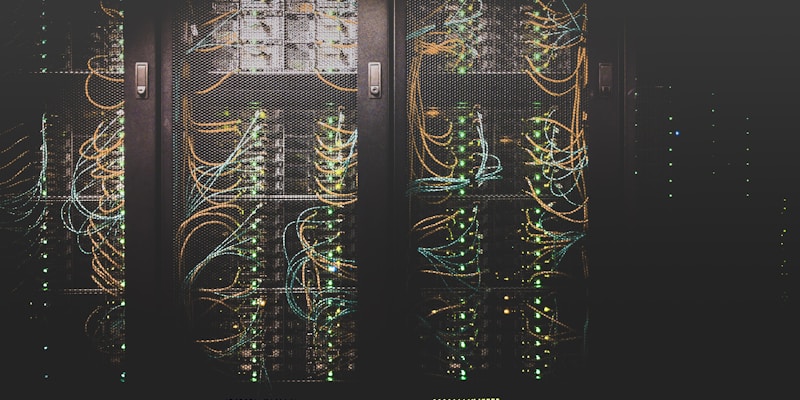
*Modern data centers are consuming unprecedented amounts of capital as AI clusters expand. Image: Unsplash*
Model Development represents the second-largest allocation. Alibaba's "full-stack AI" strategy spans everything from its self-developed Pingtouge "Zhenwu" chips to the Qwen family of large language models to consumer applications like the Qwen Office suite. The company has poured resources into training increasingly large models, with the Qwen3-Max flagship reportedly exceeding one trillion parameters.
Tencent's recent organizational restructuring — merging its multimodal and large language model teams into a unified "Foundation Model Department" under Chief AI Scientist Yao Shunyu — signals a strategic focus on consolidating model development efforts. The company's Hunyuan Hy3 model briefly topped the global OpenRouter API call rankings in July 2026, validating its technical investments.
Application Deployment is where the spending war meets the end user. ByteDance's Doubao app, which surpassed DeepSeek to become China's most-used standalone AI application, is just the beginning. The company recently launched "Doubao Work," an AI agent product deeply integrated with Feishu (the Chinese equivalent of Slack/Microsoft Teams) that can autonomously decompose complex tasks, gather information, and produce documents, spreadsheets, and presentations.
Even Tesla has recognized the power of China's AI ecosystem. In a surprising move announced in late August 2026, Tesla began pushing a software update to its Chinese vehicle fleet that integrates ByteDance's Doubao large model directly into the in-car infotainment system — marking the first time Tesla has adopted a third-party AI model anywhere in the world.
| Spending Category | Typical Share of AI Capex | Key Examples |
|---|---|---|
| GPU / AI Chip Procurement | 40–55% | NVIDIA H200, Huawei Ascend 910B, Cambricon MLU |
| Data Center Construction | 25–35% | Hyperscale facilities in Inner Mongolia, Guizhou, Xinjiang |
| Networking & Storage | 10–15% | 800G optical modules, NVLink interconnects, all-flash arrays |
| Model Training Operations | 5–10% | Cloud compute for training runs, data pipeline infrastructure |
*Source: Industry analyst estimates based on public disclosures and supply chain reports.*
The Revenue Question: Is Any of This Paying Off?
For all the spending, the critical question remains: where's the return?
The early signs are promising but incomplete. Alibaba reported that its AI-related products generated RMB 123.76 billion in revenue during the June quarter, marking the 12th consecutive quarter of triple-digit year-over-year growth. AI products now represent over 30% of Alibaba Cloud's external commercial revenue, which itself grew 45% — the fastest pace in 22 quarters.
"Alibaba's full-stack AI technology investment has officially crossed the initial incubation phase and entered a positive cycle of scaled commercial returns," CEO Eddie Wu declared on the earnings call. It was a carefully crafted message designed to reassure investors that the spending would eventually translate into profits.
Baidu's AI business has become the company's primary growth engine. In Q1 2026, AI-related revenue reached RMB 13.6 billion, representing 52% of Baidu's general business revenue. Founder Robin Li has positioned AI as "Baidu's core driving force," a notable pivot for a company historically dependent on search advertising.
Tencent's AI monetization is more diffuse but no less significant. The company's Hunyuan model powers an expanding array of features across WeChat — from AI-generated content suggestions to intelligent customer service bots to document analysis tools in Tencent Docs. While Tencent doesn't break out AI-specific revenue, the integration of AI capabilities into its massive existing product ecosystem represents a different monetization path than Alibaba's cloud-centric approach.
| Company | AI Revenue Indicator | Latest Figure | Growth Rate |
|---|---|---|---|
| Alibaba | AI product revenue | RMB 123.76 billion (quarterly) | Triple-digit YoY (12th consecutive quarter) |
| Baidu | AI business revenue | RMB 13.6 billion (Q1 2026) | 52% of general business revenue |
| ByteDance | Doubao MAU / Token volume | 345 million MAU; 120 trillion daily tokens | Token volume 1,000x since May 2024 launch |
| Tencent | AI-integrated product features | Embedded across WeChat, QQ, Tencent Cloud | Not separately disclosed |
*Sources: Company earnings reports, industry estimates.*
The Talent War: 17,000 Recruits and Counting
The spending war extends beyond hardware and data centers into human capital. In March 2026, ByteDance and Tencent simultaneously announced their largest-ever campus recruitment drives, collectively targeting more than 17,000 new hires — with AI and research roles heavily prioritized.
ByteDance's "ByteIntern" program offered over 4,800 research and development positions, a record high, with full-time conversion rates expected to exceed 50%. Tencent expanded its technology and product roles by 39% and 36% respectively, with AI-related positions seeing the most aggressive expansion.
The hiring spree reflects a deeper reality: the bottleneck in China's AI race isn't just chips and servers — it's the people who can design, train, and deploy the next generation of models. Companies are paying premium salaries to attract top talent from competitors, universities, and overseas research institutions.
ByteDance's organizational restructuring in August 2026 further illustrates this human-centric approach. The company merged its Feishu product team with its Doubao product team under a unified leadership structure, while integrating Feishu's go-to-market operations with Volcano Engine's enterprise sales force. The message was clear: organizational efficiency matters as much as capital efficiency in the AI race.
What Comes Next: Three Scenarios
As 2026 progresses, China's AI spending war is entering a critical phase. Three possible scenarios are emerging:
Scenario 1: The Payoff — AI revenue growth accelerates across all four companies, validating the massive investments. Alibaba's cloud AI revenue sustains triple-digit growth. Tencent's AI-integrated WeChat features drive advertising and payment volume. ByteDance's Doubao becomes a monetization engine rivaling TikTok's advertising business. By 2027, the market views 2026's spending as prescient rather than reckless.
Scenario 2: The Shakeout — Revenue fails to keep pace with spending. Investor pressure forces at least one major player to scale back. Tencent's negative free cash flow becomes a sustained pattern rather than a temporary blip. ByteDance's private valuation comes under pressure as spending erodes profitability. The industry consolidates around two or three winners, with weaker players retreating to application layers rather than competing on infrastructure.
Scenario 3: The Pivot — US sanctions or supply chain disruptions force a strategic reorientation. NVIDIA's advanced chips become unavailable, and domestic alternatives from Huawei, Cambricon, and others prove insufficient for frontier model training. Companies shift from "more chips" to "better algorithms," emphasizing efficiency gains over raw compute scaling. The spending war transforms into an efficiency war.
The most likely outcome is a hybrid of all three: some players will see their bets pay off, others will be forced to retrench, and the entire industry will face mounting pressure to demonstrate returns on what is shaping up to be the largest capital deployment in Chinese technology history.
The Stakes Couldn't Be Higher
Back in that Shenzhen conference room, as the initial shock of the negative cash flow number faded, Tencent's executives faced a room of skeptical analysts. The message they delivered was both simple and audacious: the company was willing to sacrifice short-term profitability for long-term AI dominance.
"This level of investment reflects our conviction that AI represents a generational opportunity," the management team stated. "We are building the infrastructure that will power the next decade of technology."
The same conviction is echoing across Hangzhou, Beijing, and every other Chinese tech hub. Alibaba is spending half its three-year AI budget in less than twelve months. Baidu has committed over RMB 100 billion since 2023. ByteDance is reportedly prepared to spend nearly half a trillion dollars over the next several years.
Whether this collective bet represents visionary leadership or collective madness won't be clear for years. But one thing is certain: China's technology industry has never bet this big on anything. And in a race where the prize is nothing less than dominance of the defining technology of the 21st century, walking away isn't an option.
The spending war has no off-ramp. The only question is who can afford to stay in it the longest.
What Readers Are Saying
Zhihu user @TechObserver
"腾讯自由现金流转负是信号,不是终点。二十年来腾讯第一次烧这么多钱,说明AI是真的被当成生死战来打了。"
*"Tencent's negative free cash flow is a signal, not an endpoint. For the first time in twenty years, Tencent is burning this much money — it shows AI is being treated as an existential battle."*
Xiaohongshu user @FinanceGirl2026
"字节跳动一年花4759亿?这已经超过很多国家的GDP了。未上市公司能烧这么多钱,背后资本得多有信心啊。"
*"ByteDance spending 475.9 billion in one year? That's more than the GDP of many countries. For an unlisted company to burn this much, the capital behind it must be incredibly confident."*
Weibo user @硅谷回流工程师
"我在硅谷做了八年AI infra,现在回国了。国内给的package比美国高30%,而且项目更有冲击力。大厂抢人已经抢到北美了。"
*"I worked on AI infrastructure in Silicon Valley for eight years and just returned to China. Domestic compensation is 30% higher than the US, and the projects are more impactful. The big companies are poaching talent all the way from North America."*
Twitter/X user @ChinaTechBrief
"The scale of China's AI capex is underreported in Western media. Tencent + Alibaba + Baidu + ByteDance could spend $150B+ in 2026. That's comparable to Meta + Microsoft combined. The infrastructure race is truly global."
Douban user @反内卷斗士
"这些钱如果能拿出一半来改善程序员的工作环境和减少996,可能比多买一万张GPU对社会贡献更大。"
*"If even half this money went toward improving programmers' work environments and reducing 996 culture, it might contribute more to society than buying another 10,000 GPUs."*
GitHub user @open-source-fighter
"Interesting that Alibaba's Qwen is open source and getting massive adoption, while ByteDance keeps Doubao proprietary. Different strategies, same spending level. The open vs closed question in China AI is going to be fascinating to watch."
Related Articles
- Alibaba's Qwen Ecosystem: How One Open-Source Model Reached a Billion Downloads
- Tencent's Hunyuan Hy3: The AI Turnaround Story Nobody Expected
- Huawei's Ascend 950 SuperPod: The Chip That Could Free China From NVIDIA
- Stanford AI Index 2026: China's Quiet Rise to the Top
*Last updated: August 31, 2026*
Editor at AI in China. Tracking Chinese AI companies, funding rounds, and the technologies reshaping global tech. More about me.