From Entity List to World No. 3: Inside YMTC's Record $4.9 Billion IPO

heroImage: "https://images.unsplash.com/photo-1617791160505-6f00504e3519?w=1200"
*Photo: A 3D NAND wafer from Wuhan. Four years after US export controls were designed to freeze its technology, YMTC filed the largest IPO in Chinese exchange history. Image: Unsplash*
On the evening of August 21, 2026, the Shanghai Stock Exchange published a filing that would have been unthinkable four years earlier. Yangtze Memory Technologies — YMTC, the Wuhan-based NAND flash manufacturer that the United States placed on its Entity List in December 2022 — had formally submitted its IPO application. The ask: ¥33 billion ($4.9 billion). That is larger than any IPO in the history of the STAR Market, China's Nasdaq-style technology board, eclipsing the ¥29.5 billion record set just weeks earlier by its sister company, DRAM maker ChangXin Memory Technologies.
The prospectus underneath that number tells a story that sanctions architects did not plan for. In the first quarter of 2026, YMTC generated ¥47.04 billion in revenue and ¥33.38 billion in net profit — a 71% net margin that means the company earned roughly ¥371 million ($52 million) per day. Its NAND gross margin hit 78.73%. It holds 14% of global NAND flash shipments, having passed Kioxia, Micron, and SanDisk in a single quarter. And in February 2025, Samsung — Samsung, the world's largest memory maker — signed a patent licensing agreement with YMTC to use its hybrid bonding technology in next-generation 400-plus-layer NAND.
The bet in Washington had been that cutting YMTC off from American equipment would freeze it at the technological frontier until it withered. Instead, the company turned the blockade into a cage match it ultimately won. This is how it happened, and what it means for the AI era now arriving.
The Numbers Beneath the Filing
Before the narrative, the snapshot. The prospectus filed on August 21 contains financials that most semiconductor companies, anywhere in the world, would struggle to match in their best year — let alone their first profitable quarter of a supercycle.
| Metric | 2023 | 2024 | 2025 | Q1 2026 |
|---|---|---|---|---|
| Revenue (¥B) | — | 45.20 | 63.19 | 47.04 |
| Net profit (¥B) | -19.18 | 6.77 | 14.21 | 33.38 |
| NAND gross margin | ~1% | — | — | 78.73% |
| Net margin | — | ~15% | ~22% | ~71% |
| Daily net profit (Q1) | — | — | — | ¥371M ($52M) |
| Cumulative losses (to Mar 2026) | — | — | — | ~¥3.4B remaining |
To appreciate the reversal, consider the trajectory. In 2023, YMTC posted a ¥19.18 billion loss as the global memory market collapsed and its access to advanced foreign equipment vanished. Its gross margin fell to roughly 1% — technically selling chips, economically standing still. The company survived on injections from state funds and bank consortiums, raising round after round while its fabs kept running below optimal economics.
Then AI rewrote the demand curve. In 2024 the company turned profitable with ¥6.77 billion in net profit. In 2025 it earned ¥14.21 billion. And in the first three months of 2026 alone, it earned more than double its entire 2025 result — one quarter generating ¥33.38 billion, ahead even of CXMT's ¥24.76 billion in the same period. As of March 31, 2026, the accumulated losses from two decades of build-out had narrowed to roughly ¥3.4 billion — about one week of Q1 profit. The historical baggage is, for practical purposes, gone.
Twenty Years to a Working Chip
YMTC did not emerge from a venture studio or a university spin-out. It is the product of two decades of patient, frequently unfashionable state-backed industrial policy — and one architectural gamble that nearly failed.
The lineage begins in 2006, when Wuhan's municipal government and the East Lake development zone funded Wuhan Xinxin, a 12-inch wafer fab initially aimed at DRAM. The project struggled against both technology gaps and a brutal industry cycle, and pivoted to foundry work — but it preserved something precious: a fab, a team, and the institutional knowledge of how to run a memory production line.
In 2016, with China's National Integrated Circuit Industry Investment Fund — the "Big Fund" — as anchor investor, YMTC was formally established in Wuhan's Optics Valley, absorbing Wuhan Xinxin as a wholly-owned subsidiary. At the time, more than 90% of the global high-end storage market was controlled by Samsung, SK Hynix, Micron, Kioxia, SanDisk, and Western Digital. Foreign engineers were dismissive in ways that became famous inside the company: the Chinese could build houses and high-speed rail, the line went, but they could not build 3D NAND.
YMTC's answer was Xtacking — an architecture no incumbent was using at scale. Instead of building memory cells and their peripheral control circuits on a single wafer, Xtacking fabricates each on its own optimized wafer and then bonds the two together with billions of vertical interconnects. The payoff: faster I/O speed, better yield, and — critically for a company under tightening export controls — an architecture built on its own patent estate rather than licensed foreign process steps.
The early years were desperate. Company lore holds that in the darkest laboratory stretch, teams working on the bonding process saw 1,000 test channels connect successfully in exactly 3. Internal and external verdicts were uniform: the architecture was too hard, yields too low, costs too high. The team persisted. In October 2017, China's first domestically designed 3D NAND wafer completed validation. In 2018, Xtacking was unveiled publicly, drawing genuine surprise from an industry that had expected a me-too follower. In September 2019, 64-layer TLC NAND entered mass production — ending China's history of having no domestically produced 3D NAND at all.
The Architecture That Outran the Blockade
What makes Xtacking strategically interesting is not that it works — though it works impressively — but that it became the industry's direction of travel while YMTC was supposedly frozen in place.
| Generation | Year | Milestone | Industry Context |
|---|---|---|---|
| Xtacking 1.0 | 2018–2019 | Architecture unveiled; 64-layer TLC mass production | First China-designed 3D NAND architecture |
| Xtacking 2.0 | 2020–2021 | 128-layer QLC X2-6070 verified; 128-layer mass production | Highest bit density of any announced flash part |
| Xtacking 3.0 | 2022 | 232-layer mass production | Among world's first 200+ layer NAND |
| Xtacking 4.0 | 2024 | Fourth-gen; FMS "Most Innovative Memory Technology" award | Hybrid bonding validated as the scaling path |
| X4-6080 QLC | 2025–2026 | Industry-first 2Tb 8-plane QLC, 3,600 MT/s I/O | Densest QLC die in production |
| 267-layer | 2026 | Mass production underway; 300+ layer in development | Matching the leading edge layer-for-layer |
Here is the detail that reframes the sanctions story. In October 2022, the US Bureau of Industry and Security restricted exports of equipment capable of producing 128-layer-and-above NAND. Two months later, YMTC was added to the Entity List. The design intent was clear: strand the company below the 200-layer mark while Samsung and SK Hynix raced to 400, 500, and 1,000-layer roadmaps.
Instead, hybrid bonding — the technique at the heart of Xtacking — turned out to be the industry's answer to scaling, because stacking more layers on a single wafer runs into stress and yield limits that bonding sidesteps. In February 2025, Samsung signed an agreement licensing YMTC's hybrid bonding patents for use in its own next-generation 400-plus-layer products — reportedly the first time a Chinese memory company has licensed core patents to a top-tier foreign rival. The student had started invoicing the teacher.
By 2026, YMTC is mass-producing 267-layer NAND and developing beyond 300 layers, comfortably inside the global first tier. The company holds cross-licensing arrangements with major international players and, by its own account in the prospectus, ranks among the few mainland Chinese chip firms with patent parity against overseas incumbents.
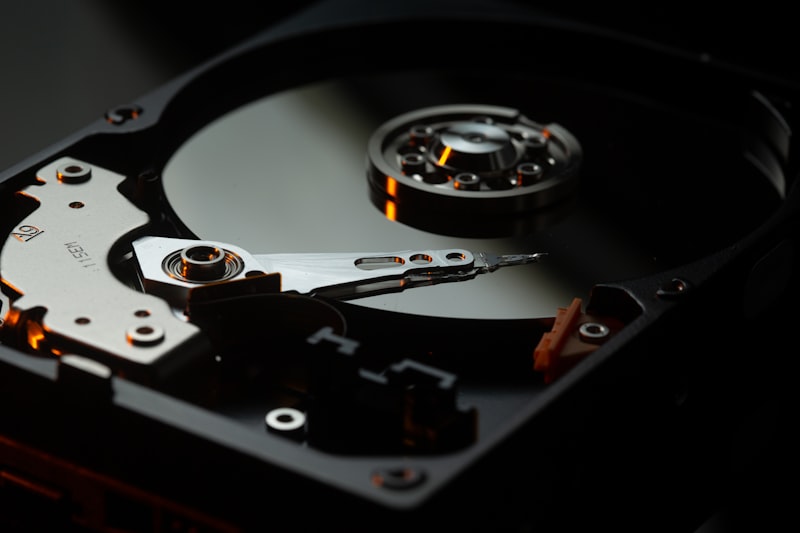
*Xtacking's hybrid-bonded architecture — memory array and logic circuits on separate wafers, joined by billions of vertical channels — became the industry's scaling roadmap while YMTC was supposedly frozen. Image: Unsplash*
Unit Economics of a Supercycle
Margin stories this extreme usually mean one of two things: a monopoly, or a cycle peak. YMTC's is a cycle — but a cycle whose underlying demand driver has changed character.
The prospectus discloses indexed unit economics that show the operating leverage of a memory fab when prices, utilization, and technology align. Against a 2023 baseline of 100, the average selling price per gigabit climbed to 225 in 2024, dipped to 194 in 2025, and then exploded to 529 in Q1 2026. Over the same period, manufacturing cost per gigabit fell 20.2% in 2024, another 20.8% in 2025, and 9.4% more in early 2026. The ratio of cost to selling price compressed from 1.97 — losing money on every bit — to 0.21.
| Index (2023 = 100) | 2024 | 2025 | Q1 2026 |
|---|---|---|---|
| ASP per gigabit | 225.11 | 194.13 | 529.43 |
| Cost per gigabit | 157.00 | 124.38 | 112.71 |
| Cost-to-ASP ratio | 0.70 | 0.64 | 0.21 |
| NAND share of revenue | — | — | 96.4% |
The price spike is not speculative froth. It reflects the single biggest structural shift in memory demand in a decade: AI inference is devouring storage. As AI workloads migrate from training — which is compute-dominant — to inference at scale, the data written, cached, and archived per query explodes. Enterprise SSDs accounted for 48% of all NAND bits shipped globally in Q2 2026, up from 26% a year earlier, as cloud providers stockpile high-capacity drives. Counterpoint reports that global NAND industry revenue hit an all-time record in that quarter, up five-fold year over year.
One caution belongs in any honest analysis: 78% gross margins are not a normalized state for a cyclical commodity. Every previous memory supercycle — 2017–2018 most recently — ended in a price collapse that punished anyone who extrapolated peak margins. YMTC's own prospectus notes the risk, and some research houses project a possible price downturn around 2028. What the bulls counter with is the composition of demand: this cycle is anchored not in smartphone upgrades but in datacenter buildouts that are structurally multi-year.
The AI Angle: From Consumer Chips to Datacenter Storage
If the financials are the supercycle, the strategic story is YMTC's long-delayed pivot into the enterprise — and the AI inference era is the wedge.
Historically, YMTC's revenue leaned heavily on consumer applications: wafers and dies sold to storage module makers (50.8% of Q1 2026 revenue), and its own-brand ZhiTai consumer SSDs and embedded storage (35.5%). High-margin enterprise SSDs for datacenters were just 10% of revenue — the reason the company ranks a humbler fifth globally by revenue despite its third-place shipment share.
That gap is precisely what the ¥33 billion raise is engineered to close. In March 2026, YMTC launched three PCIe 5.0 enterprise drives — the PE501, PE511, and PE522 — built on Xtacking 4.0, with capacities up to 122.88 terabytes per drive. All three have reportedly entered batch supply at Alibaba Cloud and Tencent Cloud. Alibaba has signed an annual purchase intention for 232-layer NAND covering roughly 15% of its domestic procurement, and ByteDance is running pilot deployments.
| Drive | Interface | Max Capacity | Target Segment | Status |
|---|---|---|---|---|
| PE501 | PCIe 5.0 | — | Datacenter read-intensive | Batch supply |
| PE511 | PCIe 5.0 | — | Datacenter mixed-use | Batch supply |
| PE522 | PCIe 5.0 | 122.88 TB | AI/datacenter high-capacity | Batch supply |
| ZhiTai consumer line | PCIe 4.0/5.0 | 4 TB | Consumer/enthusiast | Shipping |
The logic of AI storage demand is straightforward and compounding. Inference models produce checkpoints, embeddings, logs, and KV-cache overflow at volumes training runs never did. A datacenter serving a billion daily AI queries writes orders of magnitude more data than one serving search results. Every one of China's hyperscalers — Alibaba, Tencent, ByteDance, Baidu — is in a capex arms race for AI infrastructure, and storage is 20–30% of every AI server bill of materials. YMTC wants to be the default supplier of that slice, and it is competing on the one axis that matters to a hyperscaler CFO: cost per terabyte at acceptable reliability.

*Enterprise SSDs held 48% of global NAND bit shipments in Q2 2026 — up from 26% a year earlier — as AI inference workloads turned datacenters into the industry's dominant storage buyer. Image: Unsplash*
The New Memory Map
YMTC's rise redraws a market that was, for three decades, one of the most stable oligopolies in technology. The shakeout of 2026 is remarkable for its speed.
| Vendor | Q2 2026 Shipment Share | Revenue Rank | Position |
|---|---|---|---|
| Samsung | 25% | 1 | Volume leader; licenses YMTC hybrid bonding patents |
| SK Hynix | 22% | 2 | Strong in HBM and enterprise |
| YMTC | 14% | 5 | Passed Kioxia for #3 in shipments; consumer-heavy mix |
| Kioxia | ~13% | 4 | Server slowdown dents growth |
| Micron | — | 4–5 | Revenue ahead of YMTC on richer mix |
| SanDisk | — | — | Fifth pillar of the old order, now behind |
Two facts stand out. First, Q2 2026 was the first quarter in history that YMTC's bit shipments exceeded Kioxia's — and TrendForce data puts it third globally by both revenue and shipments in Q1. Second, YMTC's fifth-place revenue rank despite third-place volume is a pricing problem, not a demand problem: consumer NAND sells for a fraction of enterprise SSD pricing, which is exactly the mix shift the IPO proceeds are funding.
Meanwhile, the capital markets verdict arrived early via CXMT. China's DRAM champion listed on July 27, 2026, raising ¥29.5 billion, and within weeks its market capitalization blew through ¥4 trillion — briefly overtaking Tencent as the most valuable company on China's A-share market. Brokerages that had modeled CXMT at ¥2–3 trillion pre-listing looked timid within a month. With that comp in place, some institutions now model YMTC's eventual valuation in the ¥1 trillion range, roughly triple the ~¥330 billion implied by a static 10%-float, ¥33 billion raise — though the usual caveats about cycle peaks apply with full force.
The IPO structure itself is a study in state architecture. YMTC has no controlling shareholder. Hubei Changsheng holds 26.54%, Xinfei Technology 25.35%, and the Big Fund's first and second vehicles hold 11.97% and 11.38% respectively, with Wuhan municipal funds and bank investment arms filling out the register. Of the ¥33 billion raise, ¥20.8 billion (63%) funds production-line upgrades in Wuhan and ¥12.2 billion (37%) funds advanced R&D — no new land, just more layers, more yield, and more enterprise qualification.
What Could Go Wrong
A record IPO priced on peak-cycle margins invites skepticism, and the bear case writes itself. Four risks deserve honest weighting.
The cycle turns. Memory is the most cyclical major semiconductor category. NAND contract prices rose 70–75% in Q2 2026; nothing in the history of this industry sustains that slope. A 2028 downturn is the consensus risk case, and YMTC's 78% gross margin would compress violently in it.
Equipment ceilings remain. The Entity List still constrains access to the most advanced lithography and deposition tools. YMTC has engineered brilliantly around the restrictions — domestic tool substitution in etch and deposition is reportedly deep — but each new layer count tightens the vise. Above 300 layers, the tool question becomes existential again.
Enterprise qualification is slow. Hyperscaler SSD qualification cycles run 18–24 months, and reliability failures are fatal to vendor standing. YMTC's 122.88TB drives are in batch supply at two hyperscalers, but displacing Samsung and SK Hynix as primary — rather than secondary — supplier will take years, not quarters.
Consumer concentration cuts both ways. A consumer-heavy mix juiced the Q1 margins when spot prices exploded, but consumer demand is also the first to collapse in a downturn. The mix shift to enterprise is the strategy; until it executes, the P&L remains a leveraged bet on consumer pricing.
What Comes Next
The near-term milestones are procedural but load-bearing. YMTC's application entered the inquiry stage in early September 2026, with the exchange's written queries and company responses now cycling. The optimistic case has the company listed by the end of 2026; the mainstream view points to the first half of 2027. When it lists, YMTC becomes the first NAND flash manufacturer anywhere on China's A-share market.
The longer-term trajectory is set by three numbers: 267 layers in mass production today, 300-plus in development, and a Fab 3 in Wuhan adding 50,000 wafers per month of capacity in 2027 on top of roughly 200,000 wafers per month across the existing two fabs. The proceeds of this IPO buy the equipment — much of it increasingly domestic — to keep all three curves climbing.
There is a symmetry that will not escape historians of this industry. In 2016, foreign competitors said China could not build 3D NAND. In 2022, Washington concluded that blocking the tools would stop what engineering could not. In 2025, Samsung licensed the blocked company's patents. And in late 2026 or early 2027, the company that was supposed to wither will ring the opening bell on the world's most speculated technology exchange, having earned in a single quarter more than it lost in two decades.
The question the IPO prospectus leaves open is not whether YMTC survived sanctions. It is whether the rest of the global memory industry is prepared for a structurally lower cost curve, built in Wuhan, arriving at exactly the moment AI turns storage into the binding constraint of the compute era.
Social Media Reactions
微博 / Weibo:
长江存储Q1一天赚3.7亿,2023年还在巨亏191亿。存储这个周期太魔幻了,但魔幻背后是AI需求真实爆发。制裁卡了设备,卡不住人家把Xtacking玩出花来。[YMTC earned ¥371M a day in Q1 after losing ¥19.1B in 2023. The memory cycle is surreal — but behind the surrealism is a real AI demand explosion. Sanctions choked the equipment, but couldn't stop them from perfecting Xtacking.]
三星反过来买长江存储的专利授权,这在五年前谁敢信?当年说中国人造不出3D NAND,现在全球下一代闪存都绕不开中国专利。[Samsung buying patent licenses from YMTC — who would have believed that five years ago? They said China couldn't build 3D NAND; now next-gen flash worldwide can't avoid Chinese patents.]
知乎 / Zhihu:
很多人没意识到330亿募资意味着什么。长江存储要的不是钱,是锚——把国家大基金、湖北国资、银行系和二级市场绑在同一艘船上,这样下一个周期低谷再来的时候,它不会再像2023年那样靠输血续命。 [People don't realize what the ¥33B raise means. YMTC doesn't need the money — it needs an anchor, binding the Big Fund, Hubei state capital, banks, and public markets to the same ship, so the next downturn doesn't leave it surviving on transfusions like 2023.]
X / Twitter:
YMTC filed a $4.9B IPO with 78% gross margins four years after the Entity List. The sanctions didn't kill it — they forced it to build its own tooling supply chain, which is now a moat. Samsung licenses its patents. We keep calling this a failure of export controls. It might be proof they accelerate the thing they target.
Hacker News:
The detail that stands out to me: enterprise SSDs went from 26% to 48% of NAND bit shipments in one year because of AI inference. Everyone tracks GPU shortages, but storage is the silent bottleneck. A 122TB drive at Alibaba scale is a fundamentally different product from a consumer SSD, and if YMTC qualifies there, the revenue ranking flips fast.
Reddit r/hardware:
Having watched the memory market for 15 years: this is 2017 Samsung all over again, except the new Samsung is state-backed and can't be out-cycled. The counterargument is the cycle will eventually crater NAND pricing like it always does. It will. But the floor keeps moving to Wuhan either way.
*Research and analysis by the AI in China editorial team. Data sources: YMTC IPO prospectus via Shanghai Stock Exchange filings, Counterpoint Research Q2 2026 NAND tracker, TrendForce, Caixin, CLS, HDIN Research, EE Times, China Daily, company disclosures. All financial figures as of Q1/Q2 2026 reporting unless noted.*
Editor at AI in China. Tracking Chinese AI companies, funding rounds, and the technologies reshaping global tech. More about me.