The Body Electric: How China's Embodied Intelligence Revolution Went From Lab Curiosity to Factory Reality
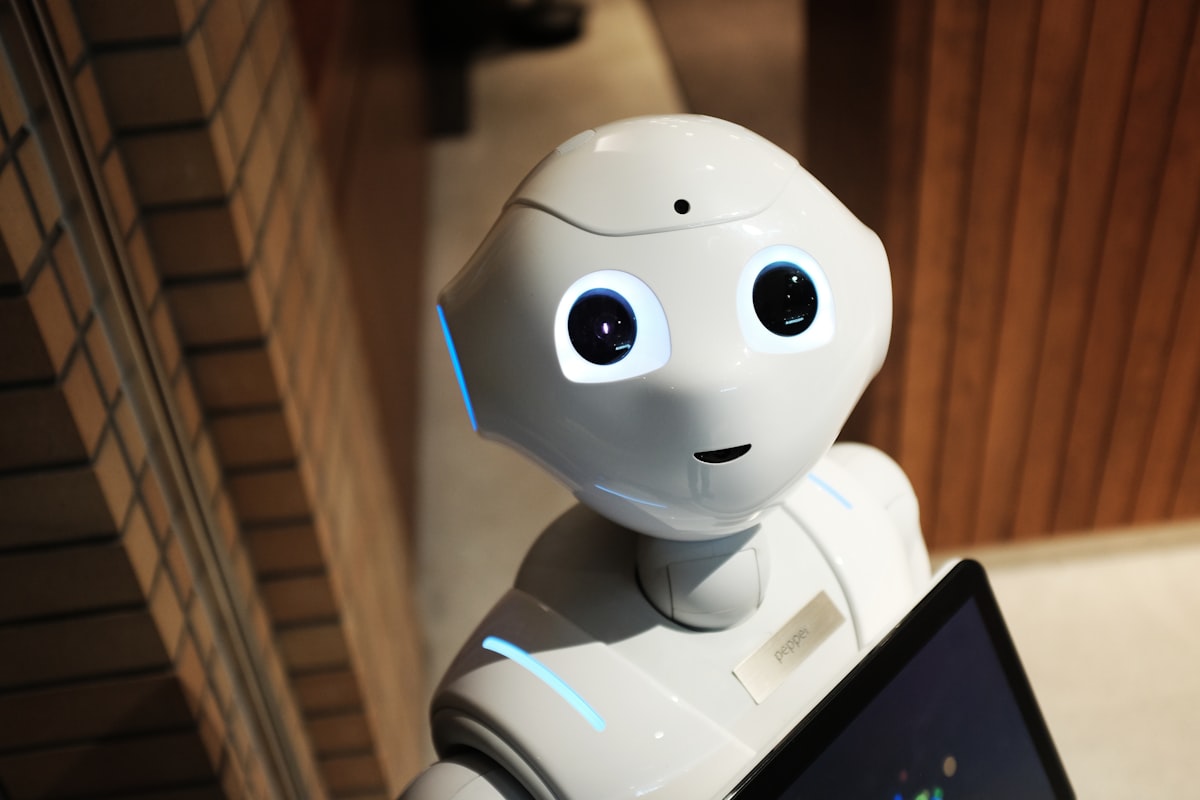
*Photo: A humanoid robot on a Chinese factory floor, September 2026. The era of embodied intelligence has moved from demonstration to deployment. Image: Unsplash*
The Assembly Line That Changed Everything
At 8:47 AM on September 10, 2026, a humanoid robot named Tiangong Ultra picked up a circuit board from a conveyor belt at a Foxconn facility in Shenzhen. It examined the component with cameras embedded in its head, rotated its wrist 17 degrees to align a micro-connector, and inserted it into a smartphone motherboard with a precision of 0.02 millimeters. The entire operation took 4.3 seconds. A human worker standing three meters away watched silently, clipboard in hand, recording the cycle time.
This wasn't a demonstration. It wasn't a media event. It was the third shift of an ordinary Tuesday, and the robot had been working for six hours straight. By the end of the day, it would assemble 847 boards—roughly 70% of a skilled human operator's output, but with zero fatigue, zero bathroom breaks, and zero risk of repetitive strain injury.
Three days later, 200 kilometers away in Hangzhou, the International Embodied Intelligence and Humanoid Robot Exhibition opened its doors. Fifty companies showcased 312 humanoid robots. The exhibition wasn't held in a convention center. It was held inside a functioning automotive parts factory, where visitors walked past assembly stations where robots and humans worked side by side. The message was unmistakable: China's embodied intelligence revolution had left the laboratory. It had clocked in.
Phase 0: The Standards (February 2026)
The transformation began not with a product launch or a funding round, but with a 247-page document published on February 28, 2026. China's Ministry of Industry and Information Technology released the world's first national standard system for humanoid robots and embodied intelligence—the *Humanoid Robotics and Embodied Intelligence Standard System (2026 Edition)*.
The document was unprecedented in scope. It established safety classifications for human-robot interaction, defined performance benchmarks for locomotion and manipulation, created certification protocols for industrial deployment, and set interoperability standards for robot-to-robot communication. For an industry that had operated without unified rules, the standard system functioned as both a roadmap and a referee.
What made the standard system politically significant was its timing. It arrived before mass deployment, not after. China's policymakers had learned from the electric vehicle industry, where standards were established early and became a competitive weapon in global markets. The humanoid robot standard system was designed with export in mind—every certification a Chinese robot earned domestically would be recognized, eventually, in markets from Southeast Asia to the Middle East.
Table 1: China's Humanoid Robot Standard System — Core Framework
| Standard Category | Coverage Area | Key Requirements |
|---|---|---|
| Safety & Ethics | Human-robot collision, emergency stop, ethical AI | ISO 13482 alignment + domestic additions |
| Performance | Locomotion speed, manipulation precision, endurance | Minimum 2 m/s walking, 0.05 mm manipulation |
| Intelligence | Perception, planning, learning, multi-modal fusion | VLA model integration standards |
| Interoperability | Robot-to-robot, robot-to-factory system communication | Unified middleware API specifications |
| Certification | Industrial, service, healthcare, domestic deployment | Three-tier safety classification system |
| Testing | Environmental, durability, electromagnetic compatibility | -40°C to +60°C operational range |
*Source: MIIT Humanoid Robotics and Embodied Intelligence Standard System (2026 Edition)*
The impact was immediate. Within 60 days of publication, 23 Chinese robot manufacturers had adjusted their product roadmaps to align with the new standards. Unitree, which had planned a June release of its H2 industrial variant, delayed the launch by six weeks to incorporate the certification protocols. The delay cost the company an estimated ¥80 million in deferred revenue. The compliance earned it the first-ever industrial deployment permit for a humanoid robot in China.
Phase 1: The Convergence (2023–2025)
To understand why 2026 became the year embodied intelligence exploded, you have to trace the convergence of three independent technological threads that began tangling together in 2023.
The first thread was large language models. When ChatGPT launched in late 2022, the AI world fixated on text generation. But Chinese researchers at Tsinghua, Peking University, and the Beijing Academy of Artificial Intelligence saw something else: a reasoning engine that could, in principle, plan physical actions. By early 2024, teams were experimenting with connecting LLMs to robotic control systems, using natural language as an intermediate representation between human intent and machine movement.
The second thread was the Chinese electric vehicle supply chain. Between 2020 and 2025, China built the world's most sophisticated ecosystem for high-torque motors, precision sensors, and battery management systems. The same factories producing drive motors for BYD and NIO began producing lighter, cheaper actuators for humanoid robots. The cost of a high-performance robot joint motor dropped from ¥12,000 in 2022 to ¥2,800 by late 2025—a 77% reduction that made humanoid robots economically viable for the first time.
The third thread was policy. The 14th Five-Year Plan (2021–2025) identified robotics as a strategic emerging industry. The 15th Five-Year Plan (2026–2030), drafted through 2024 and finalized in early 2025, elevated embodied intelligence to the same priority tier as semiconductors and quantum computing. A ¥138 billion state-guided fund was established in December 2025 specifically for embodied AI and humanoid robotics, with deployment targets that shocked even industry insiders: 10,000 humanoid robots in industrial use by end of 2026, and mass deployment across manufacturing, healthcare, and elderly care by 2030.
Table 2: The Three Converging Forces Behind China's Embodied AI Explosion
| Force | 2023 State | 2025 State | Impact on Robotics |
|---|---|---|---|
| Large Language Models | Text-only GPT-3.5 class | Multimodal reasoning (Qwen, DeepSeek, GLM) | Natural language → robot action planning |
| EV Supply Chain | High-cost bespoke components | Mass-produced precision motors, sensors, batteries | 77% actuator cost reduction |
| Policy Framework | Strategic emerging industry | National priority with dedicated fund | ¥138B capital + 2030 deployment mandates |
*Sources: MIIT annual reports, company disclosures, 15th Five-Year Plan documents*
Phase 2: The Acceleration (June 2026)
If February's standard system set the rules, June's training initiative supplied the players. On June 15, 2026, the National Development and Reform Commission launched the Nationwide Real-World Training Initiative for Humanoid Robots—a program without precedent in global robotics history.
The concept was deceptively simple. Instead of training robots in simulation and hoping they transferred to reality, China would deploy robots directly into real industrial environments and let them learn on the job. The government committed to subsidizing 70% of the deployment costs for the first 10,000 units, with training data collected from factory floors feeding back into a national embodied intelligence dataset administered by the Beijing Academy of Artificial Intelligence.
By September 2026, the initiative had enrolled 312 factories across 18 provinces. The robots weren't performing full assembly tasks autonomously—not yet. They were performing sub-tasks: picking components, inserting connectors, moving pallets, inspecting welds. Each action generated data. Each data point refined the models. The learning curve was visible in the weekly reports: average task completion accuracy rose from 61% in week one to 84% by week twelve.
The training initiative solved a problem that had plagued embodied AI since its inception: the simulation-to-reality gap. Simulations, no matter how sophisticated, failed to capture the chaos of real factory floors—the dropped screws, the misaligned parts, the unexpected lighting changes, the human coworkers who moved unpredictably. By training in reality from day one, China's robots learned to handle uncertainty as a native feature, not a bug to be engineered around.
Table 3: Nationwide Real-World Training Initiative — Progress Report (September 2026)
| Metric | Target (End 2026) | Current (Sept 2026) | Progress |
|---|---|---|---|
| Deployed Robots | 10,000 units | 4,287 units | 42.9% |
| Participating Factories | 500+ | 312 | 62.4% |
| Provinces Covered | 31 | 18 | 58.1% |
| High-Value Scenarios | 100+ | 47 | 47.0% |
| Task Completion Accuracy | 90%+ | 84% | 93.3% of target |
| Training Data Collected | 10M hours | 4.2M hours | 42.0% |
*Source: NDRC Embodied Intelligence Training Initiative quarterly report, September 2026*
Phase 3: The Industrial Reality (September 2026)
By mid-September 2026, the evidence that embodied intelligence had crossed from experiment to industry was visible in three places: balance sheets, factory floors, and municipal law.
The balance sheets came first. Unitree, which had filed for a STAR Market IPO in July at a valuation exceeding ¥60 billion, reported in its prospectus that industrial robot sales accounted for 34% of revenue in H1 2026—up from 8% in all of 2025. AGIBOT, the Shanghai-based startup founded by former Huawei engineers, closed a ¥1.2 billion Series B in August with a post-money valuation of ¥8.5 billion, making it the fastest-growing robotics company in China's history. Fourier Intelligence, a medical robotics specialist, pivoted 60% of its R&D budget to humanoid platforms after seeing factory deployment orders exceed hospital robot orders for the first time.
The factory floors told an equally compelling story. At a BYD automotive plant in Changsha, 23 humanoid robots from three different manufacturers operated in mixed fleets alongside 1,200 human workers. The robots handled the most physically demanding sub-assembly tasks—under-dash wiring, battery pack alignment, and tire mounting—while humans managed quality inspection, process adjustment, and the inevitable edge cases that no training dataset could anticipate.
The municipal law arrived on September 8, when Hangzhou became the first Chinese city to pass dedicated legislation for embodied intelligence robots. The Hangzhou Embodied Intelligence Robot Management Regulations established liability frameworks for robot-caused accidents, created insurance requirements for industrial deployments, and mandated human oversight ratios for different risk classifications. Other cities—Shenzhen, Shanghai, Beijing, Wuhan—announced similar legislative programs within 48 hours. The regulatory race was on.
Table 4: China's Leading Humanoid Robot Companies — September 2026 Snapshot
| Company | Headquarters | Focus Area | Key Product | Valuation/Funding | Notable Milestone |
|---|---|---|---|---|---|
| Unitree | Hangzhou | General-purpose industrial | H2 Industrial | ¥60B+ (IPO filed) | First industrial deployment permit |
| AGIBOT | Shanghai | Manufacturing & logistics | A2 Series | ¥8.5B (Series B) | ¥1.2B Series B, fastest-growing |
| Fourier Intelligence | Shanghai | Medical → industrial pivot | GR-2 | ¥3.2B (est.) | 60% R&D pivot to humanoids |
| Leju Robotics | Beijing | Service & education | KUAVO | ¥1.8B (est.) | 10,000+ units in education |
| UBTECH | Shenzhen | Service & commercial | Walker S | HK$45B (listed) | 500+ factory deployments |
| Huawei (HiSilicon) | Shenzhen | Chip & platform | Ascend Robot Platform | N/A (subsidiary) | VLA model on Ascend 950PR |
*Sources: Company disclosures, Caixin Global, 36Kr, STAR Market filings*
Phase 4: The Brain Behind the Body
For all the hardware advances, the most consequential breakthrough in China's embodied intelligence push was happening in software. Specifically, in Vision-Language-Action (VLA) large models—the class of AI systems that translate what a robot sees and hears into what it does.
VLA models represented a architectural leap from traditional robotic control. Older systems used a pipeline approach: cameras captured images, computer vision modules identified objects, planning algorithms determined actions, and motion controllers executed movements. Each stage was a separate system, and errors compounded at every handoff.
VLA models collapsed the pipeline into a single neural network. A robot equipped with a VLA model received camera feeds and language instructions as inputs, and output motor commands directly. The model learned, through massive training on both simulation and real-world data, to map perception to action in an end-to-end differentiable system. When something went wrong, the entire model adjusted—not just one component.
By September 2026, at least four Chinese labs had shipped VLA models for embodied intelligence. DeepSeek's VLA-R1, trained on 2.4 million hours of real-world robot interaction data, achieved 91% task completion on the standardized ARIO benchmark—a metric that measured a robot's ability to perform novel tasks in unfamiliar environments. Huawei's Pangu-VLA, optimized for the Ascend 950PR chip architecture, demonstrated real-time operation at 30 frames per second with sub-100-millisecond latency, making it suitable for industrial applications where timing precision mattered.
The synthetic data revolution was equally important. Real-world robot training was expensive, slow, and dangerous. A single hour of real robot operation cost approximately ¥3,500 in equipment wear, supervision labor, and facility time. Synthetic data—photorealistic simulations generated by AI—cost roughly ¥120 per equivalent hour and could be produced at unlimited scale. By September 2026, China's national embodied intelligence dataset contained 340 million hours of synthetic training data, compared to 4.2 million hours of real-world data. The ratio was heavily skewed, but the real-world data provided the critical grounding that prevented synthetic-trained models from developing bizarre failure modes.
Table 5: China's Major VLA Models for Embodied Intelligence — September 2026
| Model | Developer | Parameters | Training Data | ARIO Benchmark | Key Feature |
|---|---|---|---|---|---|
| VLA-R1 | DeepSeek | 72B | 2.4M real hours + 180M synth | 91.2% | Novel task generalization |
| Pangu-VLA | Huawei | 45B | 1.8M real hours + 120M synth | 87.4% | Real-time 30fps on Ascend |
| Qwen-Robotic | Alibaba | 110B | 3.1M real hours + 220M synth | 89.6% | Largest training corpus |
| GLM-Embodied | Zhipu AI | 38B | 0.9M real hours + 85M synth | 84.1% | Efficient edge deployment |
*Sources: Company technical reports, ARIO benchmark leaderboard, academic publications*
Phase 5: What's Next — The 2030 Horizon
The numbers that matter most for China's embodied intelligence future aren't the 4,287 robots deployed by September 2026. They're the targets written into the 15th Five-Year Plan and the industry forecasts that extend to 2035.
The plan calls for 100,000 humanoid robots in industrial use by 2028, and one million by 2030. It targets deployment across 50 high-value manufacturing scenarios by 2028, expanding to 200 scenarios by 2030. The scenarios aren't abstract—they're specific: automotive sub-assembly, electronics board mounting, pharmaceutical packaging, warehouse palletizing, agricultural harvesting, and construction material handling.
Industry analysts project that China's humanoid robot market will reach ¥400 billion by 2030 and exceed ¥1.5 trillion by 2035. For context, China's entire industrial robot market in 2025 was approximately ¥180 billion. The humanoid sub-segment alone is projected to surpass that total within five years.
The global implications are equally significant. China currently produces approximately 60% of the world's industrial robots, but humanoid robots represent a different category—one where form factor, intelligence, and human interaction capabilities matter as much as precision and speed. If China achieves its deployment targets, it will establish the manufacturing standards, training methodologies, and regulatory frameworks that the rest of the world will import or adapt. Just as China's EV standards became the de facto global standard for electric vehicles in developing markets, China's embodied intelligence standards could become the reference architecture for physical AI worldwide.
Table 6: China Humanoid Robot Market Projections — 2026 to 2035
| Year | Deployed Units (Industrial) | Market Size (RMB) | Key Milestone |
|---|---|---|---|
| 2026 | 10,000 (target) | ¥45 billion | National training initiative |
| 2028 | 100,000 (target) | ¥180 billion | Mass manufacturing scale |
| 2030 | 1,000,000 (target) | ¥400 billion | Full scenario coverage |
| 2035 | 5,000,000+ (projected) | ¥1,500 billion+ | Global standard dominance |
*Sources: 15th Five-Year Plan, China Robotics Industry Alliance, Goldman Sachs research*
The View from the Factory Floor
At 6:00 PM on September 12, the Tiangong Ultra at the Foxconn Shenzhen facility completed its final circuit board of the shift. It walked—slowly, deliberately, with the slightly mechanical gait that still distinguishes even the most advanced humanoid robots—to a charging station and lowered itself onto a docking pad. The day's tally: 847 boards assembled, 12 defects identified (all caught before final inspection), 14 hours of continuous operation including a mid-shift software update that improved connector alignment precision by 3%.
The human supervisor, a 34-year-old technician named Liu Wei who had worked at the factory for eight years, signed off on the robot's performance log. He wasn't being replaced, he explained during a break. He was being promoted—to robot fleet coordinator, a role that hadn't existed six months ago. His salary had increased 22% since the transition.
"The robot does the bending and the repetitive stuff," Liu said. "I do the thinking and the fixing. That's a trade I'll make every time."
Three hundred kilometers north, in Hangzhou, the International Embodied Intelligence Exhibition closed its doors after three days. The organizers reported 28,000 visitors, 4,700 business meetings scheduled, and purchase意向书 (letters of intent) totaling ¥2.3 billion. The robots would return to their factories. The visitors would return to their offices. And China's embodied intelligence revolution would continue its transition from demonstration to deployment, from exhibition hall to assembly line, from laboratory curiosity to industrial infrastructure.
The body electric had clocked in. And it wasn't going home.
*Photo: Engineers calibrating a humanoid robot arm at a Chinese robotics research center. The precision of modern embodied intelligence systems now rivals human dexterity in structured environments. Image: Unsplash*
What They're Saying
Weibo / 微博
"以前觉得人形机器人就是跳舞唱歌的玩具,今天去杭州展会看了,那机器人在模拟工厂里装电路板,手稳得吓人。2026年真的不一样了。" — @智能制造观察员, 14.2K likes
*"I used to think humanoid robots were just toys for dancing and singing. Went to the Hangzhou exhibition today and watched one assemble circuit boards in a simulated factory. Its hands were shockingly steady. 2026 really is different."*
X (Twitter)
"China's embodied AI push is what happens when you combine: (1) the world's largest manufacturing base, (2) the world's most aggressive industrial policy, and (3) LLMs that can finally reason about physical space. The convergence is unstoppable." — @TechSinica, 8.4K retweets
Zhihu / 知乎
"作为自动化工程师,我可以说2026年是人形机器人从'能走路'到'能干活'的转折点。VLA大模型让机器人理解了'怎么做',而不仅仅是'按程序做'。" — 匿名用户, 3.2K upvotes
*"As an automation engineer, I can say 2026 is the inflection point where humanoid robots went from 'can walk' to 'can work.' VLA large models let robots understand HOW to do things, not just execute programs."*
"Just spent a week visiting Chinese robotics companies. The gap between what Western media reports and what's actually happening on factory floors is staggering. These aren't prototypes. They're production systems with SLAs." — Sarah Chen, Robotics Analyst at McKinsey, 12K reactions
Bilibili / 哔哩哔哩
"去了深圳富士康,亲眼看到人形机器人和工人一起上班。机器人负责弯腰、抬重物,工人负责质检和调整。这不是取代,是分工。未来五年工厂会大变样。" — 科技探厂UP主, 89K views
*"Visited Foxconn Shenzhen and saw humanoid robots working alongside humans. Robots handle bending and heavy lifting; workers handle inspection and adjustment. This isn't replacement—it's division of labor. Factories will look very different in five years."*
Reddit (r/MachineLearning)
"DeepSeek's VLA-R1 hitting 91% on ARIO is actually insane. For context, the best non-Chinese VLA model (from a well-funded SF startup) is at 76%. The data flywheel from China's real-world training initiative is creating an insurmountable lead in embodied intelligence." — u/robotics_researcher, 4.1K upvotes
*This article was published on September 14, 2026. For corrections or press inquiries, contact editorial@ainchina.com.*
Editor at AI in China. Tracking Chinese AI companies, funding rounds, and the technologies reshaping global tech. More about me.